
Why moving data to the cloud was never the finish line — and what it takes to build a data platform that runs, governs, and improves itself.
Ask most enterprises where their data modernization journey stands, and you’ll hear a familiar story: workloads migrated to the cloud, or at least well underway. Ask what happens next, and the story gets a lot less certain.
That’s because data modernization was never really about migration. It’s about answering a harder question: how do you turn an enterprise data platform into an intelligent ecosystem that keeps delivering business value long after the migration project ends?
Today’s enterprises need platforms that are scalable, governed, AI-ready, and able to adapt as business demands shift — not just platforms that happen to run in the cloud. That’s where three things converge: Agentic AI, , and Microsoft Azure. Together, they’re changing what a modern data platform actually looks like.

Beyond Cloud Migration
Modern enterprises aren’t asking “are we in the cloud yet?” They’re asking for faster implementation cycles, quicker paths to business value, real-time insights, trusted and governed data products, AI-ready decision-making, and automated operations at scale.
Azure gives organizations a robust technology foundation to build on. But the foundation isn’t the finish line — sustainable success depends on how effectively organizations engineer and operate what they build on top of it.
Why Harness Engineering Matters
As data ecosystems grow more complex, manual processes and fragmented operations quietly become the bottleneck. Harness Engineering is a disciplined answer to that: a way of building data platforms that are automated, observable, and reliable by design, not by heroics.
By bringing Platform Engineering, DataOps, CI/CD, observability, and governance automation together, organizations get real gains: delivery of data products accelerates, platform reliability improves, operational overhead drops, governance and security standardize instead of fragmenting across teams, and engineering productivity increases.
The result is a data platform that scales without losing trust or control along the way.
Azure as the Modern Data Foundation
Microsoft Azure gives enterprises a comprehensive ecosystem for data modernization: Azure Data Factory for integration and orchestration, Azure Data Lake Storage for scalable storage, Azure Databricks and Synapse Analytics for processing, Microsoft Fabric for unified analytics, Microsoft Purview for governance, and Azure AI Foundry and Azure OpenAI for AI innovation.
Together, these services provide the foundation for building modern, cloud-native data platforms. But technology alone doesn’t create business outcomes — organizations need an operating model that connects these capabilities into a cohesive, intelligent ecosystem. That operating model is what the rest of this piece is about.
The Rise of Agentic AI — It’s No Longer Just AI
Agentic AI is the next step in enterprise automation, and the distinction matters. Traditional AI responds to specific prompts. Agentic AI systems understand objectives, plan actions, execute workflows, and adapt based on outcomes.
Inside an Azure-based data ecosystem, that means AI agents can design and optimize data pipelines, monitor data quality and reliability, enforce governance policies, recommend infrastructure optimizations, automate operational workflows, and generate business insights on their own initiative.
That shift — from platforms that are merely automated to platforms that are increasingly autonomous — is the real story here.
A Future-Ready Architecture
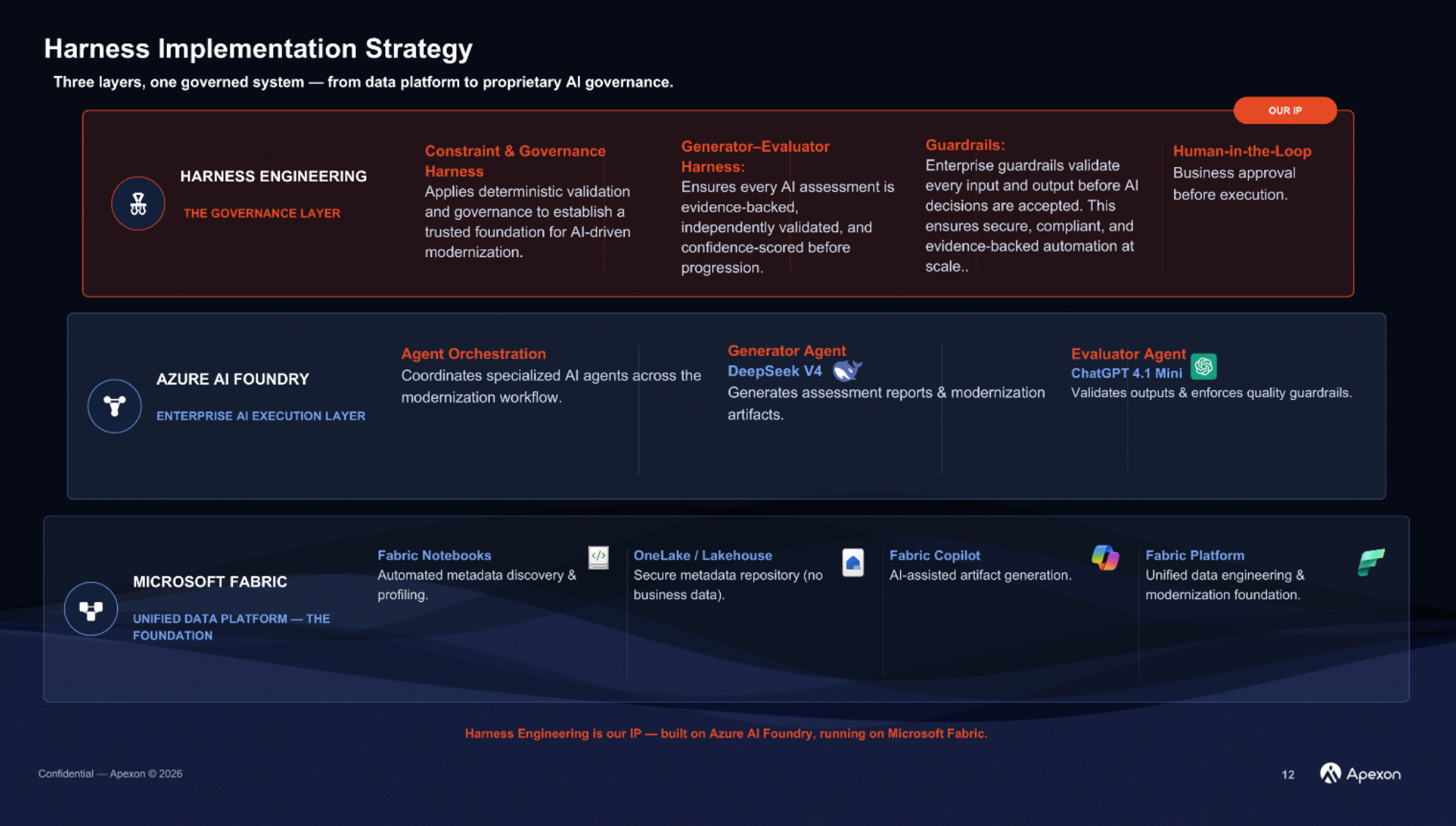
Picture the emerging enterprise data architecture as three integrated layers, each doing a different job:
1. Modern Data Platform – Azure Data Lake, Microsoft Fabric, Azure Databricks, Synapse Analytics, and real-time data services form the technical base.
2. Harness Engineering Layer – Platform Engineering, DataOps, CI/CD, observability, governance automation, and reliability engineering keep that base running cleanly.
3. Agentic AI Layer – autonomous agents orchestrate, monitor, optimize, govern, and continuously improve how the whole system operates.
Together, these three layers create something qualitatively different from a modernized data platform: a scalable, intelligent, self-improving data ecosystem.
From Blueprint to Practice: The 10-Step Architecture
What does this actually look like in an execution plan? Our AI-powered data migration and modernization architecture breaks the journey into ten steps, moving from discovery through to business consumption — with AI and human judgment paired at every stage:
1. Scan Existing Storage Systems — auto-discover RDBMS and Data Lake sources, profile data, and map dependencies before anything else moves.
2. AI-Generated Assessment Report — Harness-engineered analysis quantifies data quality, complexity, and risk, producing a report a human reviews before proceeding.
3. AI-Generated, Human-Verified Migration Plan — a target architecture recommendation, migration approach, and sequencing plan, reviewed and approved by a human before execution begins.
4. Gen AI-Created Artifacts and DB Objects — schema and DDL generation, code and mapping transformations, produced by AI and selectively approved for publish.
5. Validation of Artifacts — schema, rule, performance, and security compliance checks run before anything is allowed to proceed.
6. Historical Data Loads and Validation — data extraction, ingestion, quality checks, reconciliation, and a load validation report.
7. Batch, Stream, and Near-Real-Time Workload Creation — pipeline and workflow generation, ETL/ELT logic, orchestration, scheduling, and monitoring, built by Gen AI.
8. Data Governance — access and group migration, RBAC/ACL setup, data classification, and policy compliance, enforced from day one rather than retrofitted later.
9. Azure DevOps-Backed Automated Deployments — code repository, CI/CD pipelines, automated deployments, and infrastructure as code, promoting features cleanly from Dev to Test to Production.
10. BI App Creation for Business and End Users — semantic models, dashboards, self-service analytics, and end-user enablement, so the platform’s output actually reaches the people who need it.
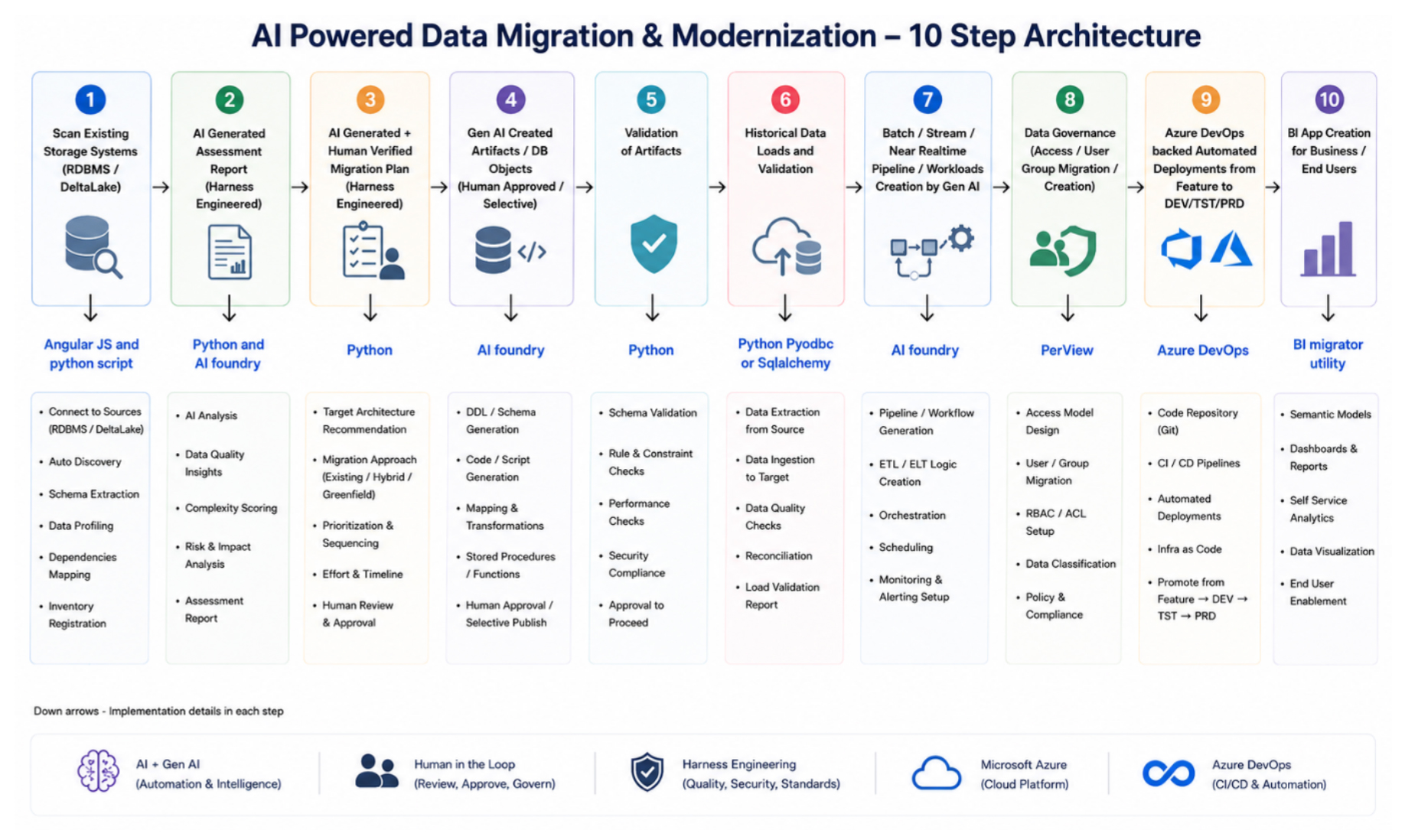
Figure 1 — AI-Powered Data Migration & Modernization: the 10-step architecture, mapped to the tools that execute each stage.
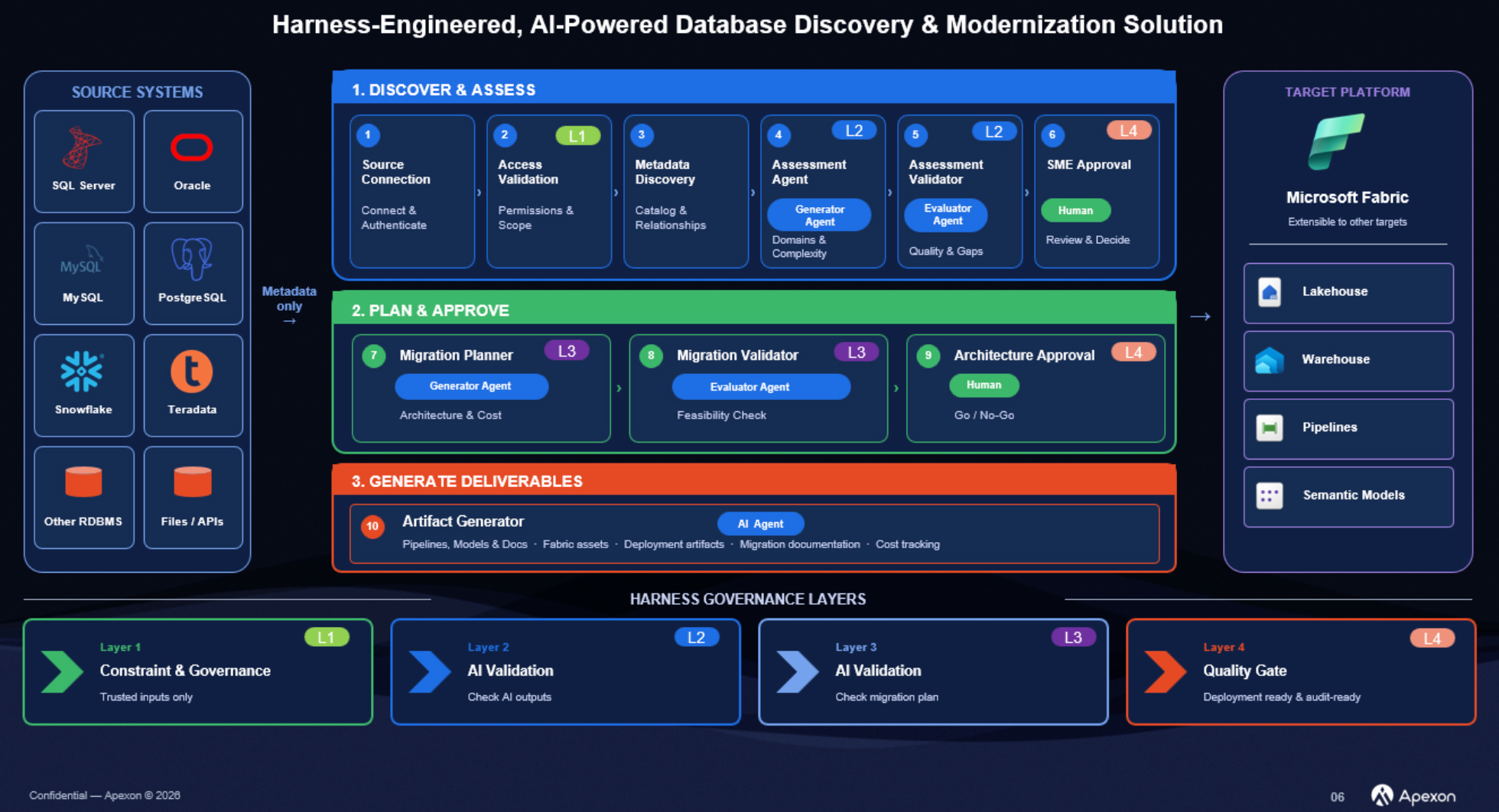
Two threads run underneath all ten steps: AI and Gen AI provide automation and intelligence at every stage, and a human stays in the loop to review, approve, and govern the outcome. That combination — not the tooling alone — is what makes the architecture trustworthy enough to run in production.
What This Means for Leaders
For CIOs, CDOs, Data Architects, and Enterprise Architects, the center of gravity is shifting — from “have we adopted the cloud?” to “are we realizing business value from what we built?”
The questions worth asking now: How quickly can data products actually be delivered? How effectively is governance enforced, rather than just documented? How much operational effort can genuinely be automated? How can AI augment engineering teams instead of just generating demos? How can the platform continuously optimize itself without waiting for the next project cycle?
Organizations that answer these well are the ones positioned to accelerate innovation, sharpen decision-making, and get real return on their data investments — not just cloud migration credit.
Final Thoughts
The future of data modernization isn’t just cloud-native — it’s autonomous.
Data Modernization provides the foundation. Microsoft Azure provides the ecosystem. Harness Engineering provides the operational discipline. Agentic AI provides the intelligence.
Organizations that bring all four together move past traditional data platforms altogether, building intelligent ecosystems that keep delivering business value in an AI-driven world — long after the migration project is closed out.
FAQs – Enterprise Data Modernization & Agentic AI
The next evolution is a shift from traditional cloud-based data platforms to intelligent, continuously improving ecosystems that combine data modernization, Microsoft Azure, Harness Engineering, and agentic AI.
Cloud migration provides modern infrastructure, but it does not automatically deliver governed data products, automated operations, faster engineering, or continuous optimization. A modern operating model is needed to turn the platform into a scalable business capability.
Harness Engineering combines Platform Engineering, DataOps, CI/CD, observability, governance automation, and reliability practices to make enterprise data platforms more automated, observable, governed, and dependable.
Agentic AI enables systems to understand objectives, plan tasks, execute workflows, and adapt based on outcomes. In modern data platforms, agents can support pipeline optimization, monitoring, data-quality operations, governance, automation, and insight generation.
Microsoft Azure provides the technology foundation for modern enterprise data platforms through services such as Azure Data Factory, Azure Data Lake Storage, Azure Databricks, Synapse Analytics, Microsoft Fabric, Microsoft Purview, Azure AI Foundry, and Azure OpenAI.
Human oversight remains part of the modernization process. AI can generate assessments, migration plans, artifacts, and automation, while people review, approve, validate, and govern the results before production execution.