
Data has become the foundation of modern enterprises, while Artificial Intelligence (AI) and Machine Learning (ML) are rapidly transforming how organizations make decisions, automate processes, and deliver customer experiences. Every day, enterprises process terabytes of data, train hundreds of machine learning models, and deploy new applications across multiple cloud environments.

The stakes of getting this wrong are not abstract. Gartner estimates that poor data quality costs the average organization $12.9 million a year, and industry surveys show the problem is getting worse, not better – average time-to-resolution for data incidents rose 166% year-over-year, and in 74% of cases, business stakeholders discover the problem before the data team does. Unity Technologies’ well-documented 2022 incident, in which corrupted training data damaged its ad-targeting models, is estimated to have contributed to a $110 million revenue loss and a roughly $4.2 billion market cap decline. These are the failure modes DataOps and MLOps exist to prevent.
As organizations scale their data and AI initiatives, they often discover that traditional software development practices are no longer sufficient. Managing data pipelines, machine learning workflows, cloud infrastructure, and governance introduces operational complexities that conventional DevOps processes were never designed to address.
This challenge has given rise to two specialized engineering disciplines:
- DataOps, which focuses on building reliable, automated, and governed data pipelines.
- MLOps, which extends DevOps principles to the complete machine learning lifecycle.
While these disciplines improve automation and operational efficiency, implementing them consistently across large organizations remains a challenge. This is where Harness Engineering provides significant value by offering a unified platform for CI/CD, Infrastructure as Code, GitOps, governance, security, and automated deployments.
In this article, we’ll explore the common challenges organizations face in DataOps and MLOps, and examine – challenge by challenge – how Harness helps overcome them.
Key Takeaways
- Harness Engineering provides a common delivery approach for software, data, and AI workflows using automation, governance, and continuous verification.
- DataOps can use CI/CD, Infrastructure as Code, GitOps, data-quality validation, and observability to make data delivery more repeatable and reliable.
- MLOps can use automated validation, deployment controls, monitoring, drift detection, rollback, and cost management to operate machine learning workloads at scale.
- Data drift and model drift require continuous production monitoring because deployed models can degrade without a conventional application deployment failure.
- AI agents can support engineering workflows by reasoning over context and proposing actions while deterministic policies, approval gates, and verification controls govern execution.
- A unified delivery backbone can connect software engineering, DataOps, and MLOps instead of operating each discipline through disconnected delivery processes.
Understanding DataOps
DataOps is a collaborative engineering practice that combines data engineering, DevOps, automation, testing, and governance to deliver reliable and high-quality data pipelines.
The objective of DataOps is simple: deliver trusted, production-ready data continuously while minimizing manual intervention.
A typical DataOps workflow includes:
- Data ingestion
- Data transformation
- Data quality validation
- Data orchestration
- Data warehouse or data lake updates
- Analytics and reporting
Unlike traditional ETL processes, modern DataOps emphasizes continuous integration, automated testing, version control, infrastructure automation, and monitoring. Its primary goals include automating data pipeline deployments, improving data quality, ensuring reproducibility, reducing deployment failures, increasing collaboration between engineering and analytics teams, and improving observability.
DataOps emerged directly out of DevOps, but in response to a problem DevOps was never built to solve: data doesn’t behave like application code. Code changes when someone commits it; data changes constantly, on its own, as upstream systems, customer behavior, and business events generate new records every second. A DevOps pipeline can assume the artifact it’s deploying is fixed the moment a build passes. A DataOps pipeline has to assume the opposite – that the underlying data will keep shifting even after the pipeline itself is considered “done.”
This is why DataOps pulls in disciplines DevOps rarely has to deal with directly. Data quality testing isn’t just checking that code compiles – it means validating schema conformity, null and duplicate rates, referential integrity, and business-rule correctness on every run, because a pipeline can execute successfully and still produce wrong output. Orchestration has to coordinate dependencies across many data sources with different freshness guarantees, not just sequence a handful of build steps. And governance has to track data lineage – where a value originated and everywhere it flowed – so that when a number in a dashboard looks wrong, someone can trace it back to its source instead of guessing.
The organizations that struggle most with DataOps are usually the ones treating it as “DevOps, but for data” without adjusting for that difference – automating deployment of pipeline code while still manually eyeballing the data quality it produces. The ones that succeed treat data quality validation as a first-class, automated pipeline stage, exactly as rigorous as a unit test, rather than a manual review step tacked on at the end.
Understanding MLOps
Machine Learning introduces an entirely new set of operational challenges beyond software deployment. Building a model is only one part of the journey. Organizations must also manage feature engineering, training pipelines, model versioning, validation, deployment, continuous monitoring, model retraining, and performance optimization. This complete operational lifecycle is known as MLOps.
Unlike traditional applications, machine learning models continuously evolve because both the underlying data and business patterns change over time. This makes automation and monitoring essential rather than optional.
What makes MLOps meaningfully harder than either DevOps or DataOps is that a machine learning model has two things that can independently go wrong, not one. The code that trains and serves the model can have a bug, the same as any application. But the model’s actual behavior – its predictions – is a product of the data it was trained on, and that behavior can degrade even when the code is perfectly correct and nothing has been redeployed. A model that was 95% accurate at launch can quietly become 80% accurate six months later purely because customer behavior shifted, with no code change and no failed test to flag it.
This is why the MLOps lifecycle has stages with no real equivalent in traditional software delivery. Feature engineering has to be consistent between training and serving, or a model will perform well in testing and fail in production simply because the live data was computed differently than the training data. Model validation has to check not just “does it run” but “is it accurate, fair, and fast enough,” against thresholds that are business decisions, not engineering ones. And monitoring has to watch two separate signals continuously: model drift (the model’s own predictive performance degrading) and data drift (the input data no longer resembling what the model was trained on) – either one can silently break a system that looks, from a pure uptime standpoint, perfectly healthy.
In practice, this means MLOps teams need automation not just to ship a model, but to know when a perfectly deployed, bug-free model has quietly become the wrong model to be running – and to retrain or roll it back before that costs the business real money.
The Value of DataOps and MLOps
Before getting into what goes wrong with either discipline, it’s worth being clear about why organizations invest in them in the first place. Neither is adopted for its own sake – both exist because the alternative (manual, ad hoc data and ML work) has a real, measurable cost, and doing it properly has an equally real payoff.
The DataOps Advantage
Faster time-to-insight: when pipelines are automated and tested rather than hand-built, a new data source or metric can go from request to trusted dashboard in days instead of weeks of manual back-and-forth between engineering and analytics.
Decisions people can actually trust: when data quality is validated automatically on every run, the business can act on a number without first wondering whether it’s right – removing the quiet tax of double-checking dashboards before every meeting.
Scale without linear headcount growth: a pipeline pattern that’s automated and version-controlled can be replicated across new data sources or teams, rather than requiring a proportionally larger data team every time the business adds a new system.
Audit and compliance readiness built in: when lineage and governance are part of the pipeline rather than an afterthought, answering “where did this number come from” for an auditor or regulator is a lookup, not a weeks-long investigation.
Less friction between teams: shared, automated workflows mean business and analytics teams stop filing tickets and waiting on data engineers for routine requests, freeing engineers to work on harder problems.
The MLOps Advantage
Faster path from notebook to production: automated validation and deployment mean a model that works for a data scientist locally can reach real users in days, rather than sitting in a manual handoff queue waiting for an engineer to translate it into something deployable.
Performance that survives contact with reality: continuous drift monitoring and automated retraining loops mean a model keeps working months after launch, instead of quietly decaying the way an unmonitored model inevitably does.
Business and reputational risk caught before it’s public: automated fairness, accuracy, and latency gates catch a bad model before it reaches customers – the difference between an internal test failure and a headline.
Cost that scales with value, not with waste: lifecycle-managed training and inference infrastructure means an ML program can grow to more models and more use cases without cloud spend growing just as fast from idle GPUs and duplicated feature computation.
A real answer to “why did the model do that”: full versioning of data, code, and model artifacts gives a defensible, reconstructable answer for any prediction the system has ever served – an expectation regulators in finance, healthcare, and insurance are increasingly formalizing, not just a nice-to-have.
Put together, the case for both disciplines is the same case, applied to two different artifacts: treating data and machine learning as products with the same reliability guarantees as production software, rather than as one-off projects that work until, quietly, they don’t. That’s the standard the rest of this article is measuring against.
How DataOps and MLOps Pipelines Work in Practice
Put side by side, the two pipelines described above share a shape even though they operate on different artifacts. Both move data or models through a sequence of stages, both need a validation gate before anything reaches production, and – critically for MLOps – the DataOps pipeline’s output is usually the MLOps pipeline’s input: the warehouse or lake that DataOps keeps clean and current is exactly what feeds feature engineering and model training downstream.
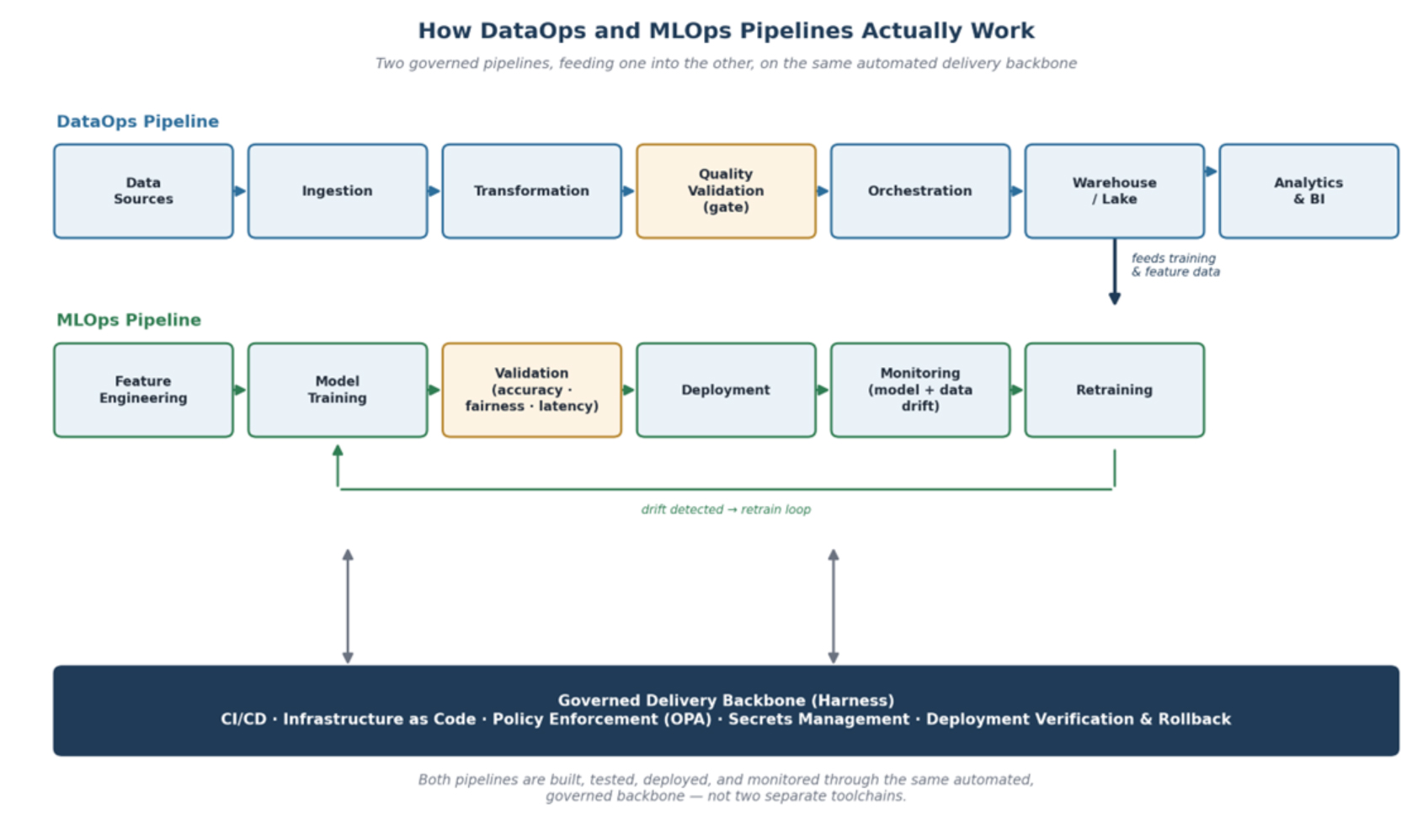
Two details in this architecture matter more than they look at first glance. First, the retraining loop in the MLOps lane isn’t optional decoration – it’s the mechanism that answers the model drift and data drift problems described earlier: monitoring feeds back into training automatically instead of waiting for someone to notice degraded predictions. Second, both lanes sit on the same governed delivery backbone rather than two separate toolchains, which is the whole argument for why a platform like Harness is relevant to both disciplines at once instead of needing a DataOps tool and a completely separate MLOps tool.
DataOps Challenges
1. Manual Pipeline Deployments
Many organizations still rely on manual deployment processes for ETL jobs, data transformations, and infrastructure changes. These manual steps often result in human errors, inconsistent deployments, missing configurations, and increased downtime.
The deeper issue is that manual deployment doesn’t just slow a team down – it makes the outcome non-repeatable. If deploying a pipeline involves someone SSHing into a server, running a script in a particular order, and remembering to update a config file, then the deployment that worked yesterday depends on that specific person’s memory today. When that person is on leave, or the step gets skipped under time pressure, the result is a deployment that looks the same on the surface but behaves differently in practice – and nobody finds out until the pipeline fails or, worse, silently produces wrong data.
2. Lack of Version Control
Without proper versioning, teams struggle to answer basic questions: which version of the pipeline is running, who deployed the latest changes, and what changed between releases. This significantly increases recovery time during failures.
This becomes especially painful during an incident. When a dashboard suddenly shows wrong numbers, the first question is almost always “what changed?” – and without version control, answering that means manually comparing files, asking around, or reconstructing history from memory instead of simply diffing two commits. Teams without versioning also lose the ability to roll back cleanly: there’s no known-good state to revert to, only a guess at what the pipeline looked like before things broke.
3. Environment Drift
Development, testing, and production environments often become inconsistent over time. Differences in Python versions, Spark versions, libraries, and infrastructure can lead to failures that are difficult to reproduce.
Drift accumulates gradually, which is what makes it dangerous: no single change causes it, but a year of small, undocumented tweaks – a package upgraded here, a config edited there – leaves production looking nothing like the environment the pipeline was actually tested against. The result is the classic “it worked in staging” failure, where a pipeline passes every test in a lower environment and then breaks in production for reasons nobody can immediately explain, because the two environments were never actually identical to begin with.
4. Data Quality Issues
Broken ETL pipelines may silently introduce missing records, duplicate data, incorrect transformations, and schema mismatches. Poor data quality directly impacts business intelligence and downstream machine learning models.
What makes this the most dangerous DataOps failure mode is that it’s silent by default. A broken build fails loudly – the pipeline won’t run. Bad data usually doesn’t: the pipeline finishes successfully, the job shows a green checkmark, and the dashboard updates right on schedule, just with numbers that are subtly or badly wrong. That gap between “the pipeline succeeded” and “the output is correct” is exactly where the earlier-cited $12.9 million average annual cost of poor data quality comes from – it’s rarely one dramatic failure, and almost always the slow accumulation of decisions made on data nobody double-checked.
5. Infrastructure Drift
Infrastructure changes performed manually often create inconsistencies across environments, making deployments unpredictable.
This is environment drift’s close cousin, but at the infrastructure layer rather than the application layer: a cluster resized by hand, a firewall rule added directly in a cloud console, a storage bucket permission changed to unblock someone during an incident and never reverted. None of these show up in version control, so nobody can look at a repository and know what the infrastructure actually looks like right now – only what it was originally supposed to look like.
6. Secret Management
Hardcoding cloud credentials, database passwords, or API keys into deployment scripts creates serious security risks.
Beyond the obvious exposure risk if a script or repository leaks, hardcoded secrets create an operational problem too: rotating a compromised credential means hunting through every script, config file, and notebook it might have been pasted into, rather than updating it in one place. Teams that centralize secrets can rotate a credential in minutes; teams that don’t often discover exactly how many places a password was copied into only after something has already gone wrong.
7. Lack of Observability
Without centralized monitoring, engineering teams often discover pipeline failures only after business users report missing dashboards or incorrect reports.
This is the pattern the Monte Carlo survey data cited earlier captures precisely: in 74% of cases, it’s a business stakeholder, not the data team, who notices something is wrong first. That ordering is backwards from what good observability should produce – the team responsible for a pipeline should know it’s degraded before the people depending on its output do, not after they’ve already made a decision based on bad numbers.
MLOps Challenges
1. Manual Model Deployment
Many organizations still deploy machine learning models manually, introducing unnecessary delays and deployment risks.
Manual model deployment usually means a data scientist exporting a model file, handing it to an engineer, and hoping the serving environment matches the training environment closely enough that it behaves the same way. Every one of those handoffs is a place where something can silently diverge – a library version, a preprocessing step performed slightly differently – and because the model still “runs” either way, the divergence often isn’t visible until predictions start looking wrong in production.
2. Model Versioning
Teams frequently struggle to identify which model is currently serving production traffic, which dataset was used for training, and which hyperparameters produced the deployed model.
This gap becomes a real liability the moment something goes wrong: if a model starts making bad predictions and nobody can say with certainty which exact model artifact, training dataset, and hyperparameter set produced it, there’s no reliable way to reproduce the problem, compare it to a previous known-good version, or explain to a regulator or auditor how a specific prediction was generated – a requirement that’s becoming non-optional in regulated industries like finance and healthcare.
3. Model Drift
Business behavior evolves over time. Customer preferences change. Fraud patterns evolve. Market conditions shift. As a result, previously accurate models gradually lose predictive performance.
The insidious part of model drift is that it happens without anyone touching the model. No one redeployed it, no one changed the code, and yet six months after launch it’s making noticeably worse predictions simply because the world it’s predicting against has moved on. A fraud model trained on last year’s fraud patterns is defending against threats that have already evolved past it – and the model itself has no way of knowing that.
4. Data Drift
Even if the model remains unchanged, production data may differ significantly from training data, resulting in degraded prediction quality.
Data drift and model drift are often confused but are actually two different failure modes worth distinguishing: model drift is about the relationship between inputs and outcomes changing, while data drift is about the inputs themselves changing – a new customer segment showing up, a sensor recalibrated to report values on a different scale, a feature that used to be reliably populated now arriving mostly empty. A model can be statistically sound and still fail badly if the data it’s being asked to score no longer resembles what it learned from.
5. Lack of Automated Validation
Deploying models without validating accuracy, latency, fairness, and resource utilization can negatively impact production systems.
Skipping this step doesn’t just risk a slow or inaccurate model – it risks deploying a model that is measurably unfair to a protected group, or one that quietly violates a latency SLA under real production load in a way it never did in a notebook. Without an automated gate checking these dimensions on every candidate model, the only thing standing between a flawed model and production is whoever happened to review it manually, which is exactly the kind of single point of failure automation exists to remove.
6. High Infrastructure Costs
GPU clusters, distributed training jobs, and cloud resources can quickly become expensive without automated lifecycle management.
The cost problem is rarely one big overspend – it’s usually dozens of small ones: a training job left running after an experiment finished, a GPU cluster sized for peak load but never scaled back down, a feature store recomputing the same features across multiple pipelines that could have shared one calculation. Individually minor, these add up to the kind of runaway spend that only becomes visible when the monthly cloud bill lands, long after the waste occurred.
7. Limited Monitoring
Many organizations lack continuous monitoring for prediction quality, model latency, feature distribution, data freshness, and infrastructure health.
The consequence of this gap is that a model can fail in production for weeks before anyone notices – not because it crashes, but because it keeps running and keeps returning predictions, just increasingly wrong ones. Uptime monitoring will show the service as healthy the entire time, because uptime and correctness are different things, and most organizations only have automated eyes on the former.
Introducing Harness Engineering
Harness is a modern software delivery platform designed to automate the complete application delivery lifecycle. Rather than replacing cloud services such as AWS, Kubernetes, Databricks, Snowflake, or SageMaker, Harness orchestrates and standardizes how these technologies are deployed and managed.
Its platform includes capabilities such as Continuous Integration (CI), Continuous Delivery (CD), GitOps, Infrastructure as Code automation, policy enforcement, secrets management, feature flags, security scanning, cloud cost management, deployment verification, and automated rollback.
It’s worth being precise about what this means: Harness does not sell a product branded “DataOps” or “MLOps.” It sells one general-purpose delivery platform, and the case for using it here is that the same CI/CD, IaC, GitOps, and governance engine that already runs application delivery can be pointed at data pipelines and ML models instead of maintaining three separate toolchains.
By centralizing these capabilities, Harness enables organizations to build standardized deployment pipelines across software, data, and AI workloads.
How Harness Solves DataOps Challenges
Instead of manually deploying Glue jobs, Terraform templates, Airflow DAGs, or Databricks notebooks, engineers can define repeatable CI/CD pipelines that execute automatically after every approved code change. Mapped directly against the seven challenges above:
Manual Pipeline Deployments → Automated CI/CD triggers the deployment the moment code is approved and merged, removing the manual, error-prone step entirely.
Lack of Version Control → Git-based version control means every pipeline and infrastructure change is tracked – who deployed it, when, and what changed – answering the exact questions teams struggle with today.
Environment Drift → Infrastructure as Code (Terraform, Terragrunt, AWS CDK) plus environment promotion pipelines ensure dev, staging, and production are provisioned identically and the same tested artifact moves through each stage.
Data Quality Issues → Automated data validation tests run as a required pipeline stage, with policy enforcement blocking promotion if quality checks fail – catching the issue before it reaches production, not after a stakeholder reports a broken dashboard.
Infrastructure Drift → GitOps continuously reconciles live infrastructure against the state defined in Git, surfacing drift automatically instead of relying on manual audits.
Secret Management → Integrated, centralized secrets management removes hardcoded credentials from pipeline scripts and configuration files.
Lack of Observability → Deployment verification and centralized monitoring flag pipeline failures immediately – directly addressing the pattern where 74% of data issues are currently caught by business stakeholders instead of engineering.
This reduces operational risk while improving deployment consistency across development, staging, and production environments.
How Harness Solves MLOps Challenges
Harness also simplifies machine learning delivery pipelines, mapped against the seven MLOps challenges above:
Manual Model Deployment → A single CI/CD pipeline automates the full path from source commit through training, validation, and deployment, removing manual handoffs.
Model Versioning → Model registration as a pipeline stage, tied to Git-based version control, records exactly which model, dataset, and hyperparameters are live in production at any moment.
Model Drift → Continuous monitoring paired with automated rollback detects performance degradation against live traffic and can trigger rollback or retraining before the drift causes business impact.
Data Drift → The same continuous monitoring tracks input feature distributions in production, flagging when live data diverges from training data – not just when the model’s output looks wrong.
Lack of Automated Validation → A validation stage in the pipeline checks accuracy, latency, fairness, and resource utilization, with policy enforcement (via Open Policy Agent) automatically approving or blocking promotion based on the result.
High Infrastructure Costs → Cloud cost management tracks and optimizes GPU and training spend inside the same platform used for the pipeline itself, rather than as a separate FinOps exercise.
Limited Monitoring → Deployment verification continuously monitors prediction quality, latency, and infrastructure health, with automatic rollback if predefined thresholds are violated.
By automating these steps, organizations can confidently deploy models with minimal manual intervention.
Agentic AI in Harness Engineering: Building Agents to Close These Gaps
Every solution described above still assumes a pipeline that follows fixed, scripted logic – automated, but not adaptive. Harness’s newest layer moves a step further. Instead of running as a static script, an individual step in a DevOps, DataOps, or MLOps pipeline can now run as a reasoning agent: one that investigates, decides, and acts within a governed boundary rather than simply executing a predefined command.
Harness calls this capability Autonomous Worker Agents, launched in June 2026, built for the work that happens between writing code and shipping it to production. Every pipeline step can run as an agent with context, governance, sandboxing, and audit trails built in – the same discipline described in every “How Harness Solves” section above, with a reasoning layer added on top of the automation layer.
Architecturally, these agents draw their context from what Harness calls the Software Delivery Knowledge Graph – a unified map of everything happening across a pipeline’s build, test, deployment, infrastructure, security, and cost history. Without that shared context, an agent troubleshooting a failure would have no visibility into the feature flag or infrastructure change that likely caused it; with it, the agent can correlate across all three automatically.
On top of this foundation, Harness ships several named agents:
Harness AI DevOps Agent – pipeline productivity assistance directly in the IDE via a VS Code extension, including monitoring pipelines, viewing logs, managing approvals, and AI-assisted debugging.
Harness AI Release Agent – handles feature and data operations such as deploying, targeting, and managing feature flags.
Harness AI Support Agent – answers product and documentation questions instantly.
Human-Aware Change Agent (part of the AI SRE module) – listens to incident conversations across Slack, Teams, and Zoom, then correlates what humans say during an incident with the actual deployment, configuration, and infrastructure changes that occurred.
Early deployments show this working in practice. One enterprise team reported cutting incident detection and resolution time from roughly 60 minutes to two or three minutes after adopting AI SRE alongside existing CI/CD telemetry integration. On the worker-agent side, a Kubernetes-troubleshooting agent built by Verint Systems reached production in about four days and now serves roughly 200 operations staff and 1,000 developers, while United Airlines built a security-remediation agent, internally named RiskSentinel, on a similar four-day timeline. Harness itself reports customers using the platform to accelerate releases by up to 75%, cut cloud costs by 60%, and achieve 10x efficiency gains – company-reported figures, not independently audited ones.
This raises the same governance question every discipline in this article has had to answer: who is allowed to let an autonomous agent act in production? Harness addresses this with a tiered Agent Marketplace – Harness Managed, Harness Certified, and Community – so a team can start from a vetted agent rather than building one from scratch, while still controlling which tier is trusted for production use. In the same spirit as the earlier caveat about Harness’s DataOps and MLOps positioning: per Harness’s own product roadmap, the Agent Marketplace is listed as an H2 2026 item and the broader agents offering is marked Limited Preview at the time of writing – this is an actively maturing capability, not a finished one.
Mapped back to DataOps and MLOps: in DataOps, the same reasoning layer can sit on top of data pipeline monitoring, investigating a broken ETL job the way a Kubernetes-troubleshooting worker agent investigates an infrastructure failure. In MLOps, an agent grounded in the Knowledge Graph can correlate a model performance drop with the exact deployment, feature flag, or infrastructure change that caused it, instead of leaving an engineer to piece that together manually mid-incident.
How These Agents Are Actually Built: The Harness Engineering Pattern
A naming clarification first, since it matters for what follows: “Harness Engineering” is also a general architectural discipline in the AI agent field – distinct from Harness, the platform discussed throughout this article. The discipline’s central idea, sometimes summarized as Agent = Model + Harness, is that a language model should be confined to genuinely generative work – decomposing intent, authoring and debugging code – while a deterministic scaffold around it owns context assembly, validation, policy, cost, credential brokering, execution, and verification. Irreversible actions are removed from the model entirely and placed behind durable, human-and-policy gates. What follows describes that general pattern; where Harness the platform implements pieces of it, that’s noted explicitly rather than assumed.
At a glance, this pattern typically looks like: an orchestrator agent decomposes intent into a typed DAG executed by a durable workflow engine, delegating to specialist workers – commonly an Infrastructure (IaC) worker, a CI/CD Pipeline worker, and a Deployment worker. These are backed by shared, mostly non-LLM services (retrieval-based context, live infrastructure state, a policy gate, and project memory) and a common tool layer wrapping Terraform, cloud CLIs, cost estimators, and policy engines like OPA. Splitting into workers buys context isolation as much as specialization: each keeps a lean, focused context window and hands off typed artifacts – a plan ID, a PR URL, an outputs map – by reference rather than passing raw context between them.
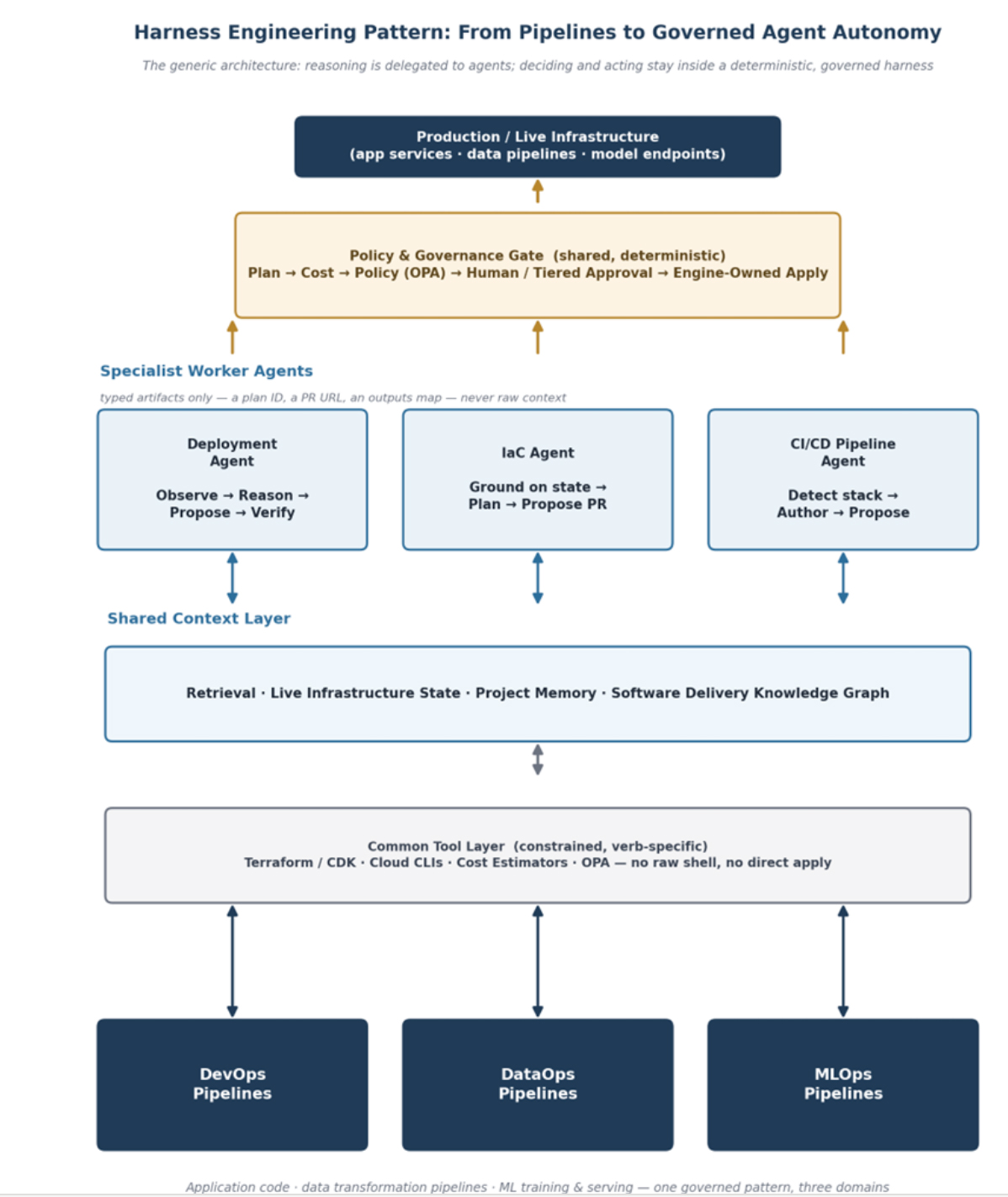
Core Design Principles
- Plan/apply separation: the agent produces a reviewable plan; a gate approves it; only then does apply run against that exact plan – never a re-derived one.
- State is ground truth: the agent reads real infrastructure state before acting, rather than assuming what exists.
- Least privilege: short-lived, scoped, brokered credentials – no long-lived keys ever enter the model’s context window.
- Everything as a PR: every change is proposed as a pull request, giving audit trail and git-based rollback for free.
- Tiered gates by blast radius: dev environments move fast; staging and production stay locked down behind stricter approval.
- Verify after act: a drift or health check closes the loop after every apply – the agent doesn’t just act and walk away.
- Constrained tool surface: the agent only has access to verb-specific tools (plan, cost-check, open-PR) – never a raw shell, never a direct apply. The tool surface is the safety boundary itself.
- Grounding before mutation: any edit not preceded by a fresh state read is rejected outright.
- Deterministic verdicts: cost and policy checks are computed by the same pure function for both the agent and the underlying engine, so an agent can’t reason its way past a check a human would also have to pass.
- Bounded retries, forced escalation: an agent gets a limited number of attempts to fix something itself before the task is escalated to a human – it terminates at a reviewable artifact, never at an unreviewed action.
Two worked examples show how this discipline plays out in practice.
The Deployment Agent
A deployment agent built on this pattern reads build and deployment logs, identifies the root cause of a failure, and proposes a fix – but the harness, not the agent, decides what happens next:
- Observe: CI/CD logs, the failing stage’s output, and the PR diff, fetched just-in-time rather than preloaded.
- Reason: correlate the failure against recent changes – a config change, a dependency bump, a flaky test – inside a sandboxed iteration loop (write, validate, fix) that has zero side effects until it’s done.
- Propose, don’t apply: the agent opens a PR with its fix and a plan; a shared policy function – the same one the underlying engine itself uses – evaluates cost and risk; a gate approves or blocks it; only the engine, never the agent, re-triggers the pipeline against that exact approved plan.
- Verify after act: once the fix is deployed, an automatic health check confirms the build actually passes and stays healthy, closing the loop instead of assuming success.
The same Observe → Reason → Propose → Verify shape carries directly into DataOps and MLOps:
- DataOps version: instead of a failing build, the agent observes a broken dbt model or Airflow DAG run, reasons about which upstream transformation or schema change caused it, and opens a PR with a fix to the transformation logic – gated and verified the same way, before the pipeline is ever re-triggered.
- MLOps version: instead of redeploying blindly, the agent observes a model validation failure, reasons about whether an accuracy, fairness, or latency threshold was violated, and proposes either blocking promotion or kicking off a retraining run – with the same deterministic policy check deciding the outcome, not the model’s own judgment.
The IaC Agent
An IaC agent built on this pattern authors and edits Terraform (or CDK/CloudFormation), but never applies its own changes:
- Ground on live state: the agent reads real infrastructure state – not the last-known config – before proposing any change.
- Plan → cost → policy → PR: it generates a plan, runs it through a cost estimator and policy checks (tfsec, Checkov, custom OPA rules), and opens a PR containing all three, so a human reviewer sees the full risk picture in one place.
- Engine-owned apply: apply is executed by the underlying workflow engine behind a durable, human-approved gate – never by the agent directly – with a drift re-check immediately before it runs, in case reality shifted since the plan was made.
- Tiered by blast radius: a dev-environment change might auto-apply after passing checks; a production change always waits on a human gate, regardless of how confident the agent’s reasoning was.
The same ground-plan-gate-verify loop applies just as directly to DataOps and MLOps infrastructure:
- DataOps version: the agent grounds on the live Terraform state behind a data warehouse, Databricks workspace, or Spark cluster, proposes a fix for drift – an untracked schema change, a manually resized cluster, a runaway compute cost – and routes it through the same plan/cost/policy/PR sequence before anything is ever applied.
- MLOps version: the agent grounds on the infrastructure behind a training or inference environment – a model-serving endpoint, a GPU training cluster, a feature store – and proposes a fix for misconfiguration or over-provisioning, again gated by a human-approved apply rather than acting on its own judgment.
Where Harness’s own Worker Agents fit into this picture: their create-configure-run model, inherited OPA governance, sandboxing, and tiered trust (Managed / Certified / Community) align with several of these principles in spirit – least privilege, everything as a PR, tiered gates by blast radius. Whether Harness’s internal implementation follows this exact orchestrator-plus-specialist-workers architecture isn’t something this article can confirm from public documentation alone; it’s presented here as the broader discipline this class of tooling is generally expected to be held to, not as a confirmed internal specification.
Example: Harness in an AWS-Based AI Platform
Consider an enterprise using AWS services for both data engineering and machine learning. A typical automated workflow may include:
- Developers push code to Git.
- Harness triggers a CI pipeline.
- Unit tests and data validation tests execute automatically.
- Terraform provisions or updates AWS infrastructure.
- AWS Glue jobs are deployed.
- Amazon SageMaker training jobs are initiated.
- Model validation is performed.
- The approved model is deployed to a SageMaker endpoint.
- CloudWatch monitors production metrics.
- Harness automatically rolls back deployments if predefined thresholds are violated.
This end-to-end automation significantly reduces deployment time while improving reliability – and it is precisely the kind of automated gate that would have caught an incident like Unity’s before corrupted data reached a production model.
Benefits of Harness
Organizations implementing Harness alongside DataOps and MLOps practices typically experience the following benefits. Given that the average organization loses an estimated $12.9 million a year to poor data quality alone, even incremental improvement in each area below compounds into a meaningful return:
Faster Delivery
Automated pipelines accelerate releases by eliminating manual deployment tasks.
Improved Reliability
Consistent deployment processes reduce configuration errors and production failures.
Better Governance
Approval workflows, policy enforcement, and audit trails improve compliance and security.
Reduced Operational Costs
Automation minimizes engineering effort while cloud cost management helps optimize infrastructure usage.
Enhanced Collaboration
Developers, data engineers, machine learning engineers, and operations teams work through standardized workflows.
Improved Developer Experience
Engineers spend less time managing deployments and more time building valuable products.
Best Practices for Successful DataOps and MLOps
To maximize the value of automation platforms like Harness, organizations should adopt the following practices:
- Store all pipelines and infrastructure definitions in Git.
- Use Infrastructure as Code for cloud provisioning.
- Automate testing for data pipelines and machine learning models.
- Validate data quality before deployment.
- Implement approval gates for production releases.
- Monitor both infrastructure and model performance continuously.
- Adopt canary deployments for production models.
- Enable automated rollback strategies.
- Secure secrets using centralized secret management.
- Continuously optimize cloud resource utilization.
Looking Ahead
As AI adoption continues to accelerate, engineering organizations are moving further into autonomous software delivery – platforms capable of not just automating fixed steps but making deployment decisions intelligently, as the Agentic AI section above already shows in early, if still-maturing, form. The next frontier extends this further: self-healing deployments, autonomous rollback decisions that require no human trigger at all, intelligent infrastructure optimization, policy-as-code enforcement applied to agent behavior itself, and unified platform engineering for software, data, and AI under a single knowledge graph.
Harness is well-positioned to support this evolution, having already shipped the first generation of this capability rather than only planning for it – providing a scalable platform that brings together automation, governance, and observability across the entire engineering lifecycle.
Conclusion
Modern enterprises can no longer treat application delivery, data pipelines, and machine learning workflows as isolated engineering activities. As systems become increasingly distributed and cloud-native, the need for automation, governance, observability, and repeatability becomes critical across all three.
DevOps established the foundation – automated, continuous delivery of application code. DataOps extends that foundation to ensure data pipelines remain reliable, scalable, and trustworthy. MLOps extends it further still to the machine learning lifecycle, enabling organizations to build, deploy, monitor, and improve AI models continuously.
Harness Engineering acts as the automation layer that ties all three practices together – not as a replacement for DevOps, DataOps, or MLOps discipline, but as the single delivery backbone that makes practicing that discipline consistently possible at scale, across software, data, and AI alike. By providing standardized CI/CD, Infrastructure as Code, governance, deployment verification, and automated rollback capabilities, Harness empowers organizations to deliver software, data, and AI solutions with greater speed, reliability, and confidence.
In an era where data and AI drive business success, adopting modern engineering practices supported by platforms like Harness is no longer a competitive advantage – it’s quickly becoming a necessity.
Sources: Gartner (average annual cost of poor data quality); Monte Carlo, “The Annual State of Data Quality Survey” (incident detection and resolution trends); IBM / Dataversity reporting on the Unity Technologies data incident; Harness (PRNewswire, June 30, 2026, “Harness Launches Autonomous Worker Agents for Software Delivery”); TechTarget, “DevSecOps AI agents add platform context, woo enterprises”; Let’s Data Science, “Harness Adds Autonomous AI Agents for DevOps Automation”; Harness Developer Hub documentation on Harness AI; “Agentic OPS – Harnessed,” an architecture abstract on harness-engineered multi-cloud DevOps agents, used as a reference for the general Harness Engineering design pattern (a discipline distinct from the Harness platform).
FAQ’s – Harness Engineering, DataOps, and MLOps
1. What is Harness Engineering in the context of DataOps and MLOps?
Harness Engineering is an approach to automating and governing software, data, and AI delivery workflows. It uses a common delivery backbone such as CI/CD, Infrastructure as Code, GitOps, governance, observability, and automated rollback to standardize DataOps and MLOps at enterprise scale.
Harness Engineering addresses DataOps challenges by automating pipeline deployment, versioning pipeline and infrastructure changes, reducing environment and infrastructure drift, enforcing data-quality checks, centralizing secrets, and improving deployment observability.
Harness Engineering supports MLOps by automating model delivery from source and training through validation and deployment. It can connect model versioning, validation gates, monitoring, drift detection, rollback, and infrastructure cost management within standardized delivery workflows.
DataOps focuses on delivering reliable, governed, production-ready data through automated pipelines, testing, orchestration, and monitoring. MLOps applies similar operational discipline to the machine learning lifecycle, including model training, validation, deployment, monitoring, retraining, and performance management.
Data behaves differently from application code because it changes continuously as upstream systems, customers, and business events generate new information. DataOps therefore requires controls for data quality, freshness, schema changes, lineage, and business-rule validation in addition to conventional software delivery practices.
Common DataOps challenges include manual pipeline deployments, inadequate version control, environment drift, data-quality problems, infrastructure drift, insecure secret management, and limited observability. These issues can make data pipelines difficult to reproduce, govern, troubleshoot, and scale.