
How AnnotateX combines AI-generated annotations, temporal tracking, cross-camera identity, LiDAR intelligence, and multimodal fusion – with human review firmly in the loop – to accelerate training-data production for the next generation of autonomous systems.
The Business Problem
An autonomous vehicle only knows what it’s been shown. A warehouse robot only avoids what it’s learned to recognize. Every perception system inherits the quality – and the blind spots – of its training data.
For a self-driving vehicle, that means learning to recognize pedestrians, cyclists, vehicles, traffic signs, road boundaries, and the unexpected obstacle that doesn’t fit any category. For a warehouse robot, it means understanding people, pallets, shelves, equipment, and navigable space. Drones and smart-mobility systems face the same fundamental challenge: before they can operate intelligently in complex environments, they need high-quality training data that captures not just what exists in a scene, but where it is, how it moves, and how multiple sensors observe it over time.

That makes richly annotated 3D video one of the most valuable inputs for modern perception systems – and one of the hardest to produce at scale.
A single multi-sensor scene can contain synchronized feeds from multiple cameras, LiDAR point clouds, calibration data, thousands of objects across time, and complex relationships between sensor views. Producing consistent annotations across all of this takes far more than drawing boxes and cuboids around objects. Annotators have to maintain object identities over time, reconcile the same physical object as it appears across multiple cameras, align 2D observations with the 3D world, interpret occlusions and ambiguous boundaries, and apply the same taxonomy consistently across thousands – sometimes millions – of frames and points.
The challenge is not simply to label more data. It is to create high-quality, temporally consistent, multimodal training data at the speed autonomous-system development now demands.
And the answer isn’t to remove humans from annotation altogether – it’s to build a better division of labor between AI and human expertise.
Read More: 7-Step Guide to Implementing Front-End Dashboards in BFSI Organizations
The Solution on the Table
Intelligent Collaboration, Not Full Automation
The most useful question for a 3D annotation team isn’t “how do we eliminate the human annotator?” It’s: which work should AI perform at scale, and where does human judgment create the greatest value?
AI is particularly effective at repetition. It can process thousands of frames using the same pipeline, taxonomy, and confidence rules – generating initial detections, propagating identities through time, comparing appearance across cameras, analyzing millions of LiDAR points, and flagging disagreements between sensor modalities.
Humans are particularly valuable when the answer is ambiguous. Is that partially visible shape behind a truck another vehicle? Do two visually similar objects seen by different cameras represent the same physical object? Is an unusual object a member of an existing class, or does the taxonomy need refinement? These are judgment calls – and no AI pipeline should be trusted to resolve them alone.
That’s the operating principle behind AnnotateX, Apexon’s AI-assisted 3D video annotation platform: automate the high-volume, repetitive work; quantify uncertainty; and direct human attention toward the cases where expert judgment matters most.
From Blank Canvas to AI-Generated First Draft
Traditional annotation starts with an empty scene. The annotator identifies an object, draws its boundary, assigns a class, repeats the process in the next frame, maintains its identity over time, and reconciles the same object across different cameras and sensor modalities. At scale, that’s an enormous amount of repetitive cognitive work.
AnnotateX changes the starting point. Instead of asking annotators to build every label from scratch, the platform uses specialized computer-vision and 3D perception pipelines to generate a review-ready first draft. The human annotator then approves, corrects, refines, or adjudicates the output.
The workflow is built around four core annotation tasks:
- 2D Object Detection — generates bounding boxes for objects in camera views, maintaining identities across frames and, where confidence permits, across cameras.
- 2D Semantic Segmentation — produces pixel-level masks for detailed scene understanding.
- 3D Object Detection — creates bounding boxes in world coordinates using LiDAR and multimodal evidence.
- 3D Semantic Segmentation — assigns semantic classes to individual LiDAR points, building a structured understanding of the 3D environment.
These tasks don’t operate as isolated AI predictions – they form a connected pipeline that accounts for time, identity, sensor geometry, multimodal evidence, confidence, and human review. That orchestration, not any single detection model, is where much of the value lies.
AnnotateX turns complex, multi-sensor data – synchronized camera feeds and LiDAR point clouds – into structured, review-ready annotations through this automated, AI-assisted workflow. Instead of starting from scratch, annotators receive a high-quality first draft to review, refine, and approve – accelerating annotation while keeping human judgment firmly in control.
Read More: Overcoming Data Quality Challenges in Healthcare
Solution Approach: Engineered for the Enterprise
A platform this central to an organization’s AI training pipeline has to be built to enterprise standards from day one – not bolted on after the fact. AnnotateX is architected as a highly scalable, secure, modular platform designed to support production annotation workloads across multiple teams and organizations at once.
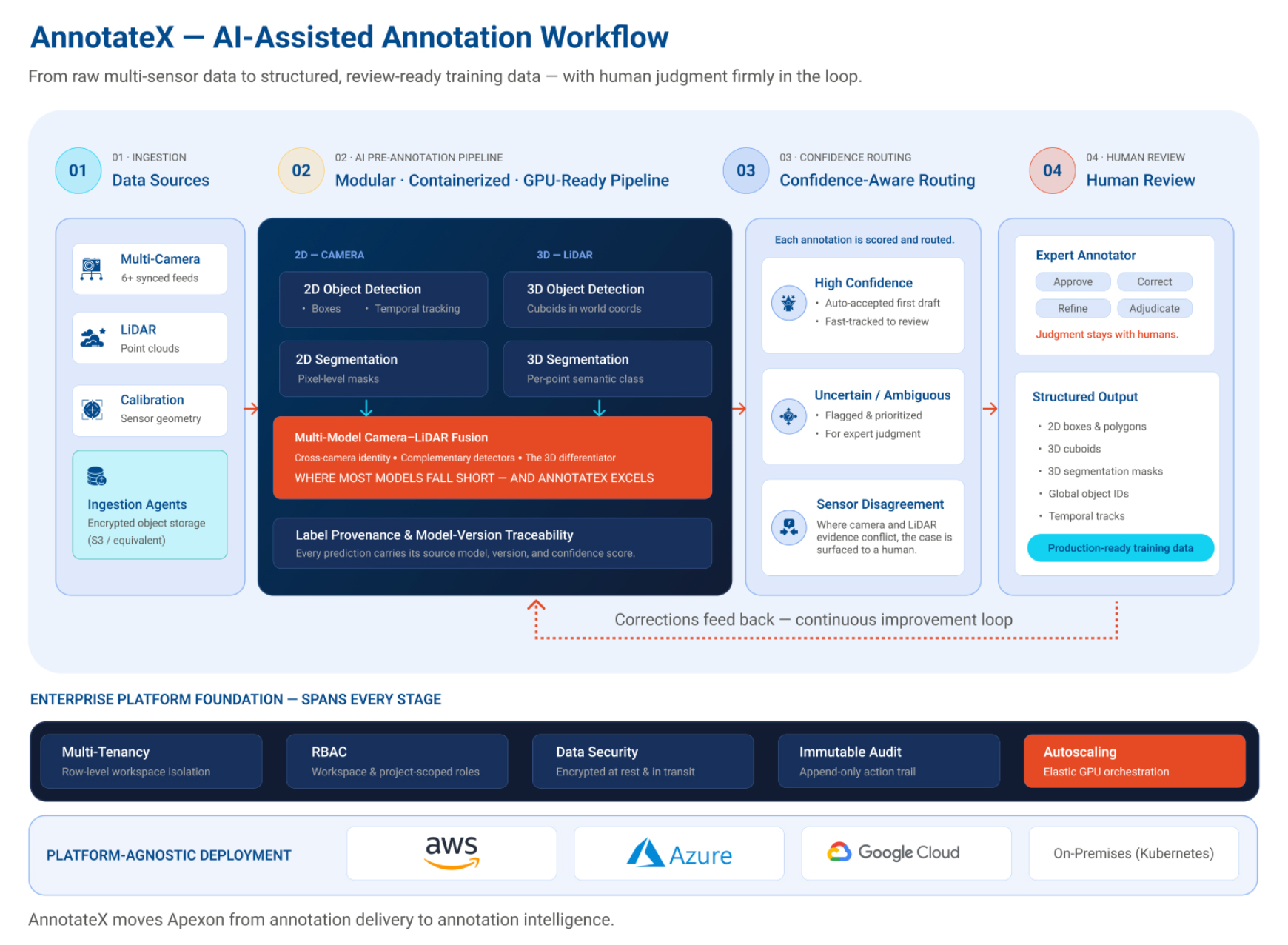
Figure 1 – The AnnotateX workflow: raw multi-sensor data flows through an AI pre-annotation pipeline, is routed by confidence, and is finalized by human review – all on an enterprise platform foundation, deployable across any cloud or on-premises.
Modular, Containerized Pipeline
AnnotateX runs as a modular pipeline of containerized, GPU-ready services. Each stage performs a specialized function and passes structured output to the next, so individual models and modules can evolve without requiring the entire annotation workflow to be rebuilt. New capabilities integrate with minimal disruption to the core orchestration layer, while model versions, confidence scores, and generated labels stay fully traceable.
Autoscaling by Design
Annotation workloads are inherently bursty – a single sensor recording session can generate terabytes of video and LiDAR data overnight. AnnotateX’s processing layer scales elastically with demand, provisioning GPU capacity for AI pre-annotation jobs as queue depth grows and releasing it when idle, so throughput matches workload without manual capacity planning.
Multi-Tenancy With True Isolation
Enterprise deployments often need to serve multiple business units, client accounts, or vehicle programs from the same platform – without any team seeing another’s data. AnnotateX enforces workspace-level isolation at the database layer, so every project, task, dataset, and label is scoped to its owning organization by construction, not convention.
Role-Based Access Control
Every workspace defines its own roles and permission sets – annotate, review, manage, export, administer – so an annotator, a reviewer, and a workspace admin each see only the actions appropriate to their role. Roles can be scoped to an entire workspace or to individual projects, giving administrators fine-grained control over who can do what, and where.
Data Security, At Rest and In Transit
All sensor data, calibration files, and generated annotations are encrypted at rest and in transit. Session authentication uses short-lived JWT access tokens with a separate refresh mechanism, so no long-lived credential sits exposed in a client application.
Built-In Auditing
Every meaningful action – a project created, a role assigned, a task approved, an export run – is captured in an append-only audit log, scoped to the workspace and attributed to the acting user. For organizations in regulated environments, or simply wanting a verifiable record of who did what and when, that trail exists from day one, not bolted on retroactively.
Together, these principles mean AnnotateX is not just an AI annotation engine – it is a platform an enterprise security and compliance team can sign off on.
Read More: A Complete Guide to Data Pipelines
The Real Differentiator: AI Algorithms Built for Video Annotation
Modern perception models are advancing fast. Today’s state-of-the-art architecture will eventually be replaced by a better one – which is exactly why the long-term value of an AI-assisted annotation platform can’t depend on any single detector, segmenter, or tracker.
The real differentiation lies in making multiple capabilities work together as a production system:
- Open-vocabulary object understanding
- Temporal tracking
- Cross-camera identity reconciliation
- LiDAR-based 3D scene understanding
- Complementary 3D detection models
- Camera-LiDAR fusion
- Confidence-aware review routing
- Human correction workflows
- Label provenance and model-version traceability
- Elastic orchestration of heterogeneous GPU workloads
3D Pre-Labelling: Where Most Models Still Fall Short
In 2D, drawing a box around an object in a camera frame is a well-solved problem, and plenty of models do it well. 3D is a different challenge entirely. LiDAR point clouds are sparse, noisy, and unstructured; objects are frequently partially occluded, and getting depth right is everything. Very few models genuinely excel at 3D pre-labelling – most overfit to their training data and work only within a narrow, pre-defined set of classes.
Apexon’s data science team tackled this gap directly. Rather than depending on any single 3D detection model – each of which proved inconsistent across datasets with diverse object categories and real-world conditions – the team built a novel multimodal fusion approach that injects 2D knowledge into 3D. This fusion architecture is what makes AnnotateX’s 3D pre-labelling meaningfully more accurate and generalizable to new datasets than LiDAR-only alternatives – and it’s the platform’s single biggest differentiator. Its modularity lets individual models evolve without requiring the entire annotation workflow to be rebuilt, because the AI landscape will keep changing, and the platform is built to change with it.
Value and Benefits
For autonomous vehicles, robotics, drones, smart mobility, and other perception-driven systems, AnnotateX turns annotation from a purely manual production task into an intelligent, measurable human-AI workflow – not automation for its own sake, but a better division of labor between artificial intelligence and human expertise.
- Faster time-to-label. AI-generated first drafts across 2D and 3D dramatically cut manual effort per scene, reducing time-to-label without cutting corners on quality.
- Consistent, production-grade quality. Human-in-the-loop review, confidence-aware routing, and consistent taxonomy application keep output at the standard production ML pipelines demand.
- Enterprise-ready security and compliance. Data isolation, RBAC, encryption, and immutable audit trails make AnnotateX viable for organizations with strict compliance and data-governance requirements.
- Full ownership and control. No dependency on a single vendor’s roadmap, licensing terms, or model choices – organizations that adopt AnnotateX own the pipeline that trains their perception systems.
- Deployment flexibility. Containerized services and cloud-agnostic architecture let AnnotateX deploy wherever an organization’s data residency, security, or cost requirements dictate.
Technology: Platform-Agnostic by Design
AnnotateX is built around containerized services and standard infrastructure primitives, reducing unnecessary coupling to any single cloud environment.
The platform is proven end-to-end on AWS, using GPU-enabled processing, container registries, object storage, serverless orchestration, and messaging services. Its architecture maps cleanly to equivalent services on Azure, Google Cloud, or Kubernetes-based on-premises infrastructure.
AWS · Azure · Google Cloud · On-Premises – the same modular architecture, deployed where your data needs to live.
The goal is architectural portability: letting organizations align deployment with their requirements for data residency, security, compliance, performance, and cost. For organizations working with sensitive sensor data, where annotation happens can matter nearly as much as how it happens.
AnnotateX moves Apexon from annotation delivery to annotation intelligence – and it’s built to prove that on your data, not just in a demo.
If multi-camera video, LiDAR, or other 3D sensor data feeds your AI systems and annotation has become the bottleneck between raw sensor data and a model you can trust, the Apexon DAAI team can run a proof-of-value engagement against your own sensor configuration, class taxonomy, quality thresholds, and deployment environment. Reach out to see what AnnotateX finds in your first scene.
FAQs – 3D Video Annotation
AI-assisted 3D video annotation uses machine learning to automate repetitive labeling tasks while human reviewers validate, correct, and refine annotations. This approach improves efficiency without sacrificing accuracy.
High-quality annotations help AI models better understand object position, motion, depth, and spatial relationships. Accurate training data improves model performance, especially for safety-critical applications such as autonomous driving and robotics.
Industries including autonomous vehicles, smart manufacturing, robotics, healthcare, logistics, retail analytics, and smart cities benefit from AI-assisted 3D video annotation because they require highly accurate spatial data for AI model training.
No. While AI significantly speeds up repetitive annotation tasks, human experts remain essential for handling complex scenarios, validating outputs, and ensuring consistent annotation quality across datasets.
Human-in-the-loop processes ensure AI-generated annotations are reviewed for accuracy, consistency, and edge cases. This improves training data quality while reducing costly labeling mistakes in production AI systems.
By automating repetitive tasks such as object tracking and pre-labeling, AI reduces manual effort while allowing experts to focus on validation and complex cases, improving productivity and lowering operational costs.