
Enterprise AI Has Entered a New Phase
There is a moment in most enterprise AI conversations when the room goes quiet. Not because the idea is too complex, but because someone has finally said out loud what everyone already knew: the data foundation isn’t ready. The dashboards don’t agree. The migration plan is still in a spreadsheet. The subject matter expert who understood the legacy schema left eighteen months ago.
AI is no longer an innovation initiative. It is becoming the operating model for modern enterprises. Yet despite significant investments in cloud, data platforms, and analytics, many organisations continue to face the same challenge: transforming complex legacy data estates into trusted, AI-ready foundations that deliver real business outcomes.
This shift was evident at Global Fabric Days 2026, where technology leaders, architects, and engineers came together to discuss a question that matters to every enterprise today: How do we operationalize AI responsibly while modernizing data platforms at scale?
Read More: Overcoming Data Quality Challenges in Healthcare
What Made This Event Different
Hosted at Microsoft’s Hyderabad campus by the Microsoft Fabric User Group Hyderabad, this event skipped the usual roadmap-slide format in favor of practitioners sharing what actually happened when they implemented these platforms in the real world.
The audience was genuinely mixed: architects, data engineers, business leaders, and students. One theme kept surfacing across sessions: organisations are done with proof-of-concepts. They want production-ready AI with enterprise-grade governance. That is a maturing ecosystem, not just a growing one.
The Challenge Enterprises Are Really Facing
Before any modernization or migration initiative can begin, organisations face a far more fundamental challenge: understanding what they already have. Enterprise databases built over decades contain thousands of interconnected objects, undocumented dependencies, embedded business rules, and legacy logic that exist only in the knowledge of a few subject matter experts.
Discovering these relationships and building an accurate migration plan is often one of the most time-consuming and resource-intensive phases of modernization. It can take weeks, sometimes months, of manual analysis, delaying projects, increasing costs, and introducing unnecessary risk before the first workload is ever migrated.
Read More: A Complete Guide to Data Pipelines
How Apexon Addressed It
Recognizing this industry-wide challenge, Apexon took a different approach. Instead of using AI to automate migration, we focused on the bigger opportunity: can AI automate the discovery process itself and generate an intelligent, reliable migration plan that enterprise teams can trust?
Achieving this required much more than applying a Large Language Model (LLM) to a database. Enterprise modernization demands deep dependency analysis, metadata intelligence, engineering guardrails, governance controls, validation mechanisms, and human oversight to ensure every recommendation is accurate, explainable, and production-ready.
This led to the development of Apexon’s Harness-Engineered, AI-Powered Database Discovery & Modernization Accelerator, a solution designed to automate one of the most time-consuming phases of modernization. By combining AI-native intelligence with structured engineering workflows, the accelerator rapidly analyzes enterprise databases, uncovers hidden dependencies, generates comprehensive discovery reports, and produces an intelligent migration plan in minutes rather than weeks. Every recommendation is validated through engineering checks and human-in-the-loop review, enabling organizations to accelerate modernization while maintaining governance, quality, and confidence.
Read More: The First Rule of Data Governance is: Don’t Talk About Data Governance
Inside the Live Demonstration
The idea only really lands when you see it working, so that’s what the session showed. On stage, the audience watched the accelerator generate an actual migration plan against a real database: a dependency table listing execution order, object names, object types, and the reasoning behind the sequencing of each object.
None of that is glamorous to describe. It’s exactly the kind of output that would normally take an architect days of cross-referencing to produce by hand. Watching it gets generated live, against real data rather than a curated sample, that shifted the room from polite attention to specific, pointed questions.
In the pictures below: Ankit Sujantee walking the audience through the live migration plan and dependency mapping on screen. Ashish Kumar presenting the Fabric and AI integration story on stage.
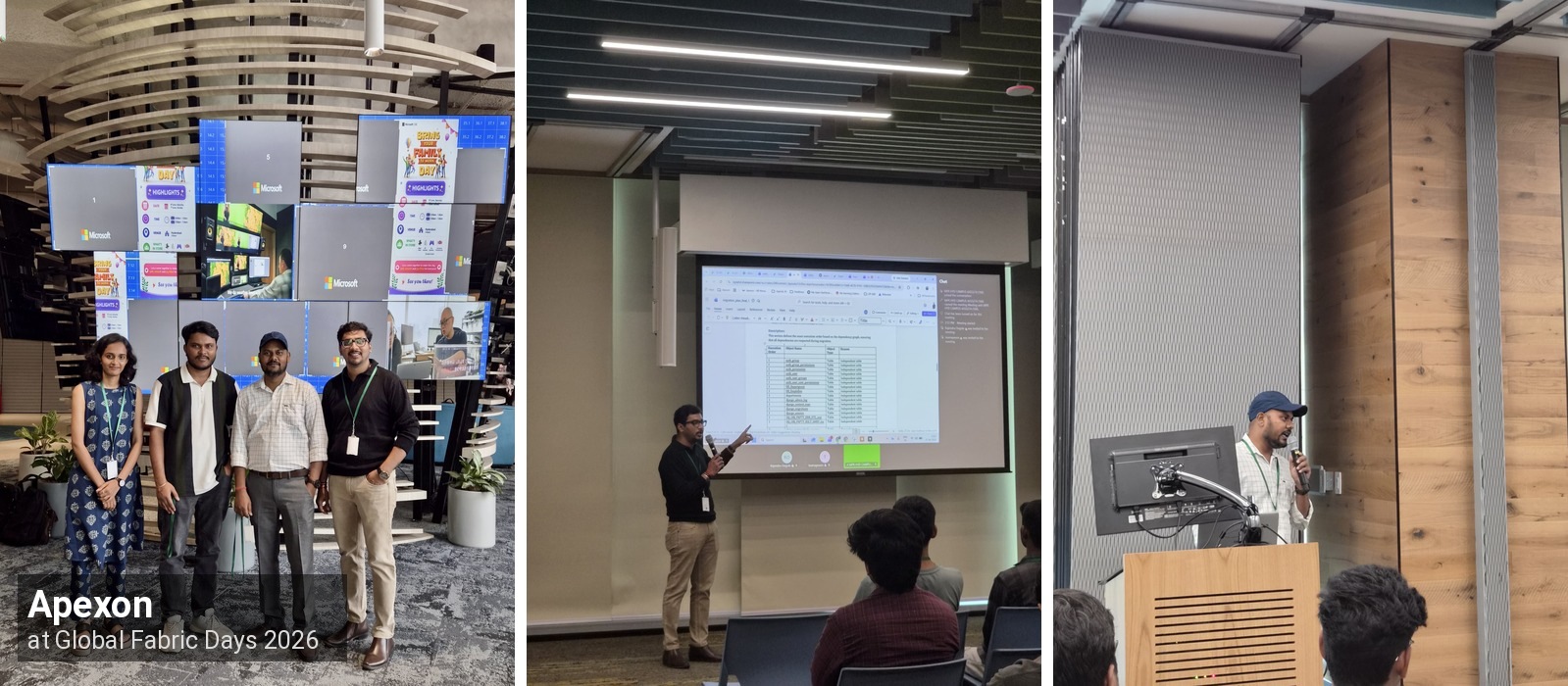
MS Fabric Practice Team, Apexon team at Global Fabric Days 2026, Microsoft campus, Hyderabad
Beyond Automation: Why Harness-Engineered AI Matters
It’s worth being precise about the word “harness-engineered,” because it is not just a label. Plenty of tools call themselves “AI-powered automation.” Automation without discipline just moves risk somewhere else, faster.
What makes an approach harness-engineered is that it is built around explicit constraints, feedback loops, and quality gates at each step. The AI doesn’t just produce an answer and move on. Every output is checked against the real dependency graph before anyone is asked to trust it. That is the difference between something you can show in a demo and something you can actually point at a production database. For a room of people trying to tell genuine AI capability apart from hype, that distinction mattered more than anything else on the slide.
What Resonated with Enterprise Leaders
The discussions following the session reflected a clear shift in how organisations are approaching AI-driven modernization. Rather than asking whether AI can support enterprise transformation, the conversation focused on how quickly these capabilities can be adopted within existing environments while maintaining governance, reliability, and engineering standards.
Technology leaders and architects were particularly interested in how the accelerator handled complex dependency analysis, validated migration recommendations, and scaled across large, heterogeneous database environments. Delivery leaders explored how AI-driven discovery could significantly reduce project timelines, accelerate migration planning, and improve delivery predictability.
The quality of these discussions reinforced a broader industry trend: enterprises are moving past AI experimentation and looking for production-ready solutions that solve real engineering challenges while delivering measurable business value
Looking Ahead
Events like Global Fabric Days 2026 reinforce that this transformation is already underway. They give technology leaders a forum to share real-world experience, challenge conventional thinking, and present innovations that solve complex enterprise problems, not just in theory but in production.
At Apexon, we remain committed to helping organisations accelerate this journey by combining AI with proven engineering practices to build modern, governed, and scalable data platforms. As a Microsoft Fabric Featured Partner, and building on our recognition as a Microsoft Fabric Real-Time Intelligence Featured Partner, a distinction held by only around 40 partners globally for proven production success, deep in-house expertise, and validated customer impact. We continue to focus on delivering enterprise-ready solutions that help customers modernize with greater speed, confidence, and measurable business value.
FAQ’s – Global Fabric Days 2026
Global Fabric Days 2026 highlighted how Microsoft Fabric and AI are transforming modern data platforms. The event covered real-world use cases, unified analytics, intelligent automation, governance, and enterprise-ready AI innovations.
Microsoft Fabric brings together data engineering, data science, analytics, business intelligence, and governance within a unified platform. This enables organizations to build AI applications faster while improving data quality, collaboration, and security.
AI enhances Microsoft Fabric by automating data preparation, simplifying analytics, generating insights, supporting natural language queries, and helping teams build intelligent data workflows with greater efficiency.
Microsoft Fabric simplifies data modernization by combining data integration, analytics, governance, machine learning, and reporting into one SaaS platform. This reduces complexity and accelerates digital transformation initiatives.
Apexon helps organizations modernize data platforms by implementing Microsoft Fabric solutions, AI-driven analytics, cloud data engineering, governance frameworks, and scalable enterprise data architectures that accelerate digital transformation.