How BFSI Firms with Under $500B AUM Can Deploy Agentic SDLC to Achieve 3-4x Developer Output – and Outpace Competitors Who Are Already Ahead
of FS firms deploying or exploring agentic AI
banking AI spend in 2025
developer output multiplier via agent teams
of FS firms at full scale – the gap is yours
Early adopters of Agentic SDLC are already achieving 3-4x developer output multipliers – while simultaneously reducing decision latency, accelerating iteration speed, and compressing lead times from commit to production. They didn’t need more resources. They made a different decision.
Mid-market banks with AUM up to $500B cannot outspend larger peers on engineering talent – but they can dramatically outpace them on productivity. Banks that have crossed into Harness Engineering (Stage 4) are pulling ahead in every delivery metric. Those still running traditional teams are structurally disadvantaged in a market where AI-native challengers operate with 1/10th the cost base.
The central thesis: traditional software delivery – human-written code, manual review cycles, tribal knowledge locked in individuals – is no longer viable under competitive and regulatory pressure. The question is no longer whether to act. The question is whether you will act before competitors compound their advantage beyond recovery.
THE APEXON DIFFERENCE Most firms deploy AI tools and hope engineers adapt. Apexon builds the operating model – the automated quality infrastructure anchored in Spec-Driven Development (SDD), the institutional knowledge framework, and the governance layer – that makes agent-driven software delivery reliable, deterministic, and consistently better than human-only teams. From our work with ScotiaBank, Mastercard, Goldman Sachs, and Fiserv, the pattern is consistent: organisations that treat AI as a co-engineer achieve sustained gains in delivery velocity, iteration speed, and regulatory confidence.
Introduction: The Developer Bottleneck in 2026
The BFSI technology landscape in 2026 is defined by an acute tension: the demand for software delivery velocity has never been higher, but the supply of experienced engineers has never been more constrained. After a period marked by Copilot deployments that delivered marginal individual gains, the industry has shifted to agentic systems that prioritise measurable engineering outcomes over feature novelty.
BFSI technology leaders now face three converging forces: business units demand weekly feature delivery, regulatory deadlines add non-negotiable engineering obligations, and AI-native challengers operate with teams a fraction of incumbent size. For mid-market banks specifically, the talent constraint is not solvable by hiring. It is solvable by fundamentally changing how software is built.
Problem Statement: The Five Developer Bottlenecks
| Challenge | Technical Manifestation | Business Impact |
|---|---|---|
| Decision Latency | Manual handoffs at every step — spec to code to review to deploy | Slow feature velocity; missed regulatory deadlines |
| Velocity Debt | 40%+ developer time on coordination, review, rework | Teams stay busy; delivery doesn’t accelerate |
| Iteration Speed | Manual spec, review, and test cycles per change | High cost per iteration; slow response to regulatory change |
| Knowledge Silos | Tribal knowledge locked in heads, Slack, PR comments | Months to onboard; critical knowledge lost with attrition |
| Review Bottlenecks | Human review is capped at 3.5 PRs/engineer/day maximum | Sprint delays; quality inconsistency at scale |
These bottlenecks compound. Decision latency at review creates velocity debt. Velocity debt slows iteration speed. Slow iterations make knowledge silos more expensive. The model is broken – and adding more engineers does not proportionally fix it.
Three forces are converging to make the status quo untenable. First, AI-native challengers operate engineering teams 5–10x smaller than incumbents. Second, the tooling has matured and results are now measurable – Goldman Sachs, deploying thousands of AI agents across its 12,000-person engineering team, projects 3–4x productivity gains vs prior tools, with 40% faster time-to-deliver on standard coding tasks (Marco Argenti, Goldman CTO, July 2025). Third, regulators increasingly accept automated governance when it is properly designed and auditable. The barriers to acting are lower than most teams believe.
Why Apexon Wins Where Others Stall
The market for agentic developer productivity is crowded with tool vendors, generalist system integrators, and cloud platform offerings – all of which share one weakness: they deploy instruments without redesigning the orchestra. Apexon’s differentiation is not the tools we use. It is the operating model we build around them.
| Competitor/Approach | Strategy | Weakness in the Agentic Era Pure |
|---|---|---|
| Pure Tooling Vendors | License the AI model. User figures out adoption. | No SDD foundation, no operating model, no governance. |
| Traditional SI Firms | Staff augmentation. Linear delivery model. | Scales with cost; cannot deliver the multiplier. |
| Cloud Platform DIY | General-purpose tools + internal trial/error. | 58%+ abandonment; no harness or governance layer. |
| In-House Engineering Teams | Build proprietary agentic platforms. | Significant talent dependency; compounding technical debt. |
The Five Principles That Create Compound Advantage
An agentic architecture built correctly creates compounding advantages. Each principle reinforces the others. Knowledge captured today makes agents smarter tomorrow. Quality gates built this sprint catch failures next sprint without additional human effort. Decision latency shrinks with every iteration. The compounding effect is the moat.
COMPETITIVE URGENCY Frontier BFSI firms achieve 3-4~ returns on Agentic SDLC investments. Laggards get $0.84 return per $1 invested. The gap between leaders and laggards is not talent – it is operating model. Every month of delay is a month of compounding disadvantage.
Architecture Overview – Five Pillars, Five Bottlenecks Solved
Apexon’s Agentic SDLC framework is five mutually reinforcing capabilities – not a vendor product catalogue. It is an architectural system built from repeated large-scale delivery transformation programmes at BFSI institutions. Each pillar addresses a specific bottleneck. Together, they compound – and together, they define the path to the AI Native operating model.
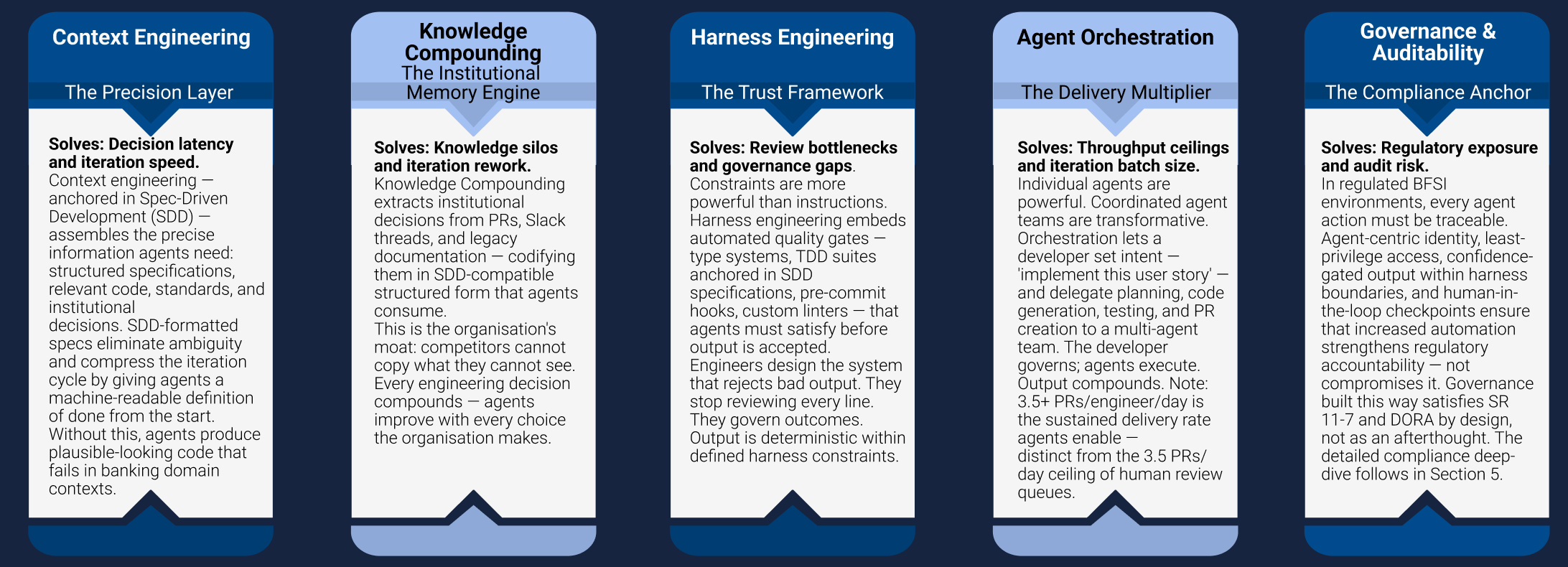
In an agentic system, quality is enforced – not inspected. Decision latency is eliminated – not managed. When all five pillars operate in concert, engineers become agent managers: they set intent, govern constraints, and compound institutional knowledge – while agents execute, test, and deliver deterministically. This is the AI Native operating model.
Spec-Driven Development: The Connective Tissue
Spec-Driven Development (SDD) is not a separate capability – it is the connective tissue across Context Engineering, Knowledge Compounding, and Harness Engineering. SDD defines a machine-readable specification format that agents use as their primary input, knowledge is structured to match, and harness gates validate against. Without SDD, agents receive ambiguous instructions and produce inconsistent output. With SDD, every agent in the pipeline operates from the same precise definition of done – making iteration fast, deterministic, and auditable from the first sprint.
The Governance Advantage: Determinism Over Consistency
The most frequent objection to Agentic SDLC in BFSI is governance risk: ‘How do we ensure agents don’t introduce compliance exposure?’ The evidence from institutions that have deployed agentic delivery systems correctly points to the opposite conclusion: automated governance is more deterministic, more auditable, and more regulatorily defensible than human review. Human reviewers are fatigued and inconsistent. Agents are tireless, deterministic within defined harness constraints, and generate a full audit trail of every decision.
For mid-market banks specifically, the governance argument is a business case, not just a risk mitigation. Lean compliance teams cannot manually review every agent output – but they can design and govern the system that does. This is a fundamentally more scalable model and it satisfies SR 11-7, Basel IV, and DORA requirements by design.
THE GOVERNANCE COMPOUNDING ADVANTAGE: For early movers, the governance advantage will compound exponentially. Institutions that embed automated governance now will have audit-ready AI systems well ahead of competitors – and well before regulators tighten scrutiny on agentic systems.
Regulatory Compliance Requirements (SR 11-7, DORA, Basel IV)

Model Inventory
Every AI agent – code generation, test synthesis, PR review – must be logged in a centralised governance inventory. Visibility into all usage, all decisions.

Explainability
High-stakes agent decisions must provide reason codes. Architecture approvals, security assessments, compliance sign-offs require traceable, auditable rationale.

Accountability
Clear ownership must identify which human or team is responsible when an agent produces incorrect output. Preserved, not eliminated, by agentic systems.

Bias Mitigation
Routine fairness testing and adversarial input checks prevent agent systems from reinforcing historical patterns that create compliance or fair lending exposure.
Security and Identity for Agent Systems
Each agent must have its own unique credentials and permissions – distinct from human user accounts – ensuring a tamper-proof audit trail of every automated action. Access is governed on the principle of least privilege: agents retrieve production configurations only when explicitly required and approved for a specific task context.
KEY INSIGHT FOR MID-MARKET BFSI FIRMS: The governance challenge for banks with under $500B AUM is not building enterprise-scale AI risk frameworks – it is embedding lightweight, practical governance from day one. Agent-centric identity and least-privilege access built early scales to any size. Governance retrofitted after scale is expensive, fragile, and often fails regulatory scrutiny.
Business Impact and Quantifiable ROI
Agentic developer productivity in BFSI is already delivering measurable business outcomes for institutions that have moved beyond pilotitis. In practice, the benefits materialise only when Agentic SDLC is deployed as an end-to-end operating model.
| Value Metric | Agentic SDLC Leaders | Traditional Teams |
|---|---|---|
| PR Throughput / Eng | 3.5+ PRs/day (agents sustain this rate) | 3.5 PRs/day ceiling (human review limit) |
| Lead Time / Changes | <2 hours for low-risk changes | 2-5 days through manual gates |
| Iteration Cycle Time | <4 hours from SDD spec to tested output | Days to weeks per change |
| Code Review Cycle | 2-4 hours (harness automated) | 1-3 days (human review queue) |
| Deployment Freq. | Multiple times per day | Weekly or bi-weekly releases |
| Governance Quality | 100% auditable, deterministic agent actions | Inconsistent human review documentation |
Impact Case Study: Mid-Market Bank ($180B AUM)
The challenge: A regional bank with $180B AUM and a 400-person engineering organisation. Senior engineers spending 35% of their time in review queues. AI IDE tooling deployed but without SDD or context engineering – producing hallucinations in domain-specific banking code. Delivery velocity stalled. Sound familiar?
The approach: Apexon deployed the Agentic SDLC Accelerator across three pilot teams, establishing SDD as the foundation, then layering harness engineering and knowledge compounding. Within 90 days: PR throughput increased 3.2x; code review cycle fell from 2.1 days to 4.8 hours; iteration cycle time halved; zero governance exceptions in compliance audit. The bank approved enterprise-wide scale investment.
PR throughput (90 days)
banking AI spend in 2025
Code review cycle reduction
Governance exceptions in audit The Agentic
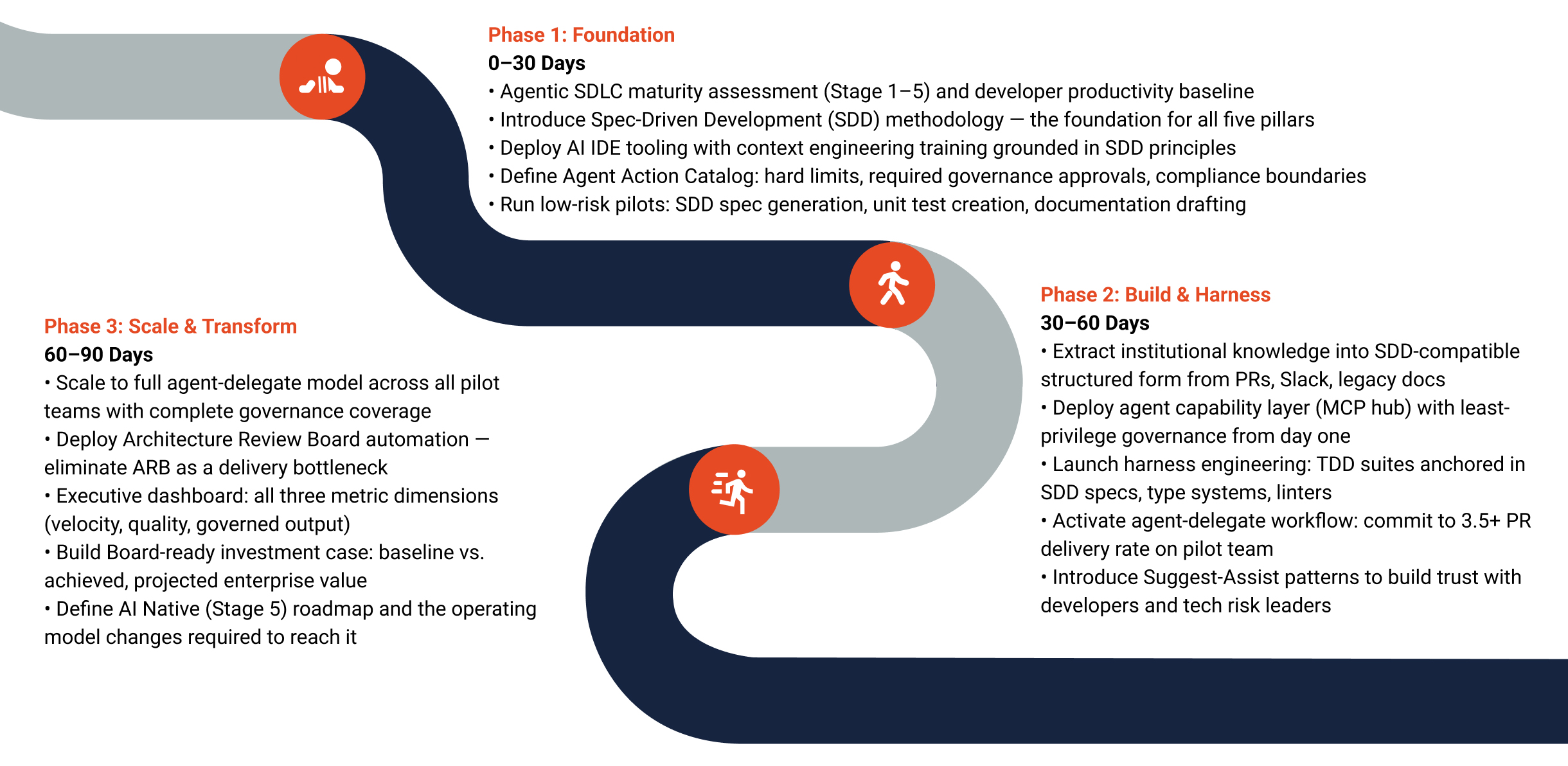
Phased Deployment Roadmap: Built for Mid-Market Velocity
A successful Agentic SDLC transformation follows a structured, risk-mitigated rollout. The approach is narrow-to-wide: prove the value on one team in 90 days, build the Board case, then scale. Trust is built methodically with developers, compliance teams, and technology risk leaders – because adoption is a people challenge, not a technical one.
Future Outlook: The Window Is Narrowing

Self-Governing Engineering Teams

Fleet-Managed Developer Platforms

Competition from AI-Native Challengers
The BFSI engineering organisation stands at a crossroads. The traditional model – human-written code, manual review cycles, and knowledge locked in individuals – has reached its structural limit. It cannot satisfy modern regulatory demands, digital-native consumer expectations, or the competitive threat of AI-native challengers.
Natively deploying Agentic SDLC is not merely an efficiency play. It is a fundamental architectural shift toward a more resilient, deterministic, and scalable engineering organisation. The Five-Pillar Architecture – Context Engineering, Knowledge Compounding, Harness Engineering, Agent Orchestration, and Governance & Auditability – each solves a specific bottleneck and together define the path to AI Native delivery.
The question for BFSI technology leaders is no longer whether Agentic SDLC is viable. It is whether your organisation is structurally prepared to deploy it – and whether you will act before competitors compound their advantage beyond recovery.
For institutions that act now: the governance advantage compounds. Automated governance built today becomes the audit-ready foundation that satisfies tomorrow’s regulatory scrutiny – before competitors have even started. The window to be a first mover in your competitive set is narrowing every quarter.
THE STRATEGIC FIRST MOVE: A 2-WEEK VELOCITY DEBT ASSESSMENT
This is not a discovery engagement. It is the precise diagnostic that gives your Board a credible, data-backed decision point – in two weeks: Where velocity debt and decision latency are highest – by team, by workflow.
The three highest-ROI automation opportunities ranked for your specific context