
Every AI project starts the same way. Someone installs LangChain, connects it to an OpenAI endpoint, and within a few hours has a chatbot that can search internal documents and summarize meeting notes. It impresses the room. It feels like a weekend well spent.
Then it goes to production.
Suddenly you’re dealing with rate limits, auth requirements, SLA commitments, and users discovering that their private documents are showing up in other people’s search results. The prototype that worked perfectly in a demo has become a liability. Making AI reliable, secure, and observable is a backend engineering problem. It always has been.
If your team runs .NET, you’re in a better position than most. The middleware, resilience patterns, and observability infrastructure are already there. The question isn’t whether .NET can support enterprise AI. It’s how to wire it up so you’re not rearchitecting the whole thing six months in.

Also Read: Two Use Cases of Digital Twins in Healthcare
.NET as the Enterprise AI Backbone
When your team first evaluated AI-powered search, the prototype almost certainly ran in a Jupiter notebook. Fast forward to production: you have auth middleware, audit requirements, existing data pipelines, SLAs, and a platform that thousands of users depend on. That platform runs .NET. The question isn’t whether to use it for enterprise AI. It’s how to architect it correctly.
The mental model shift: .NET is not a proxy
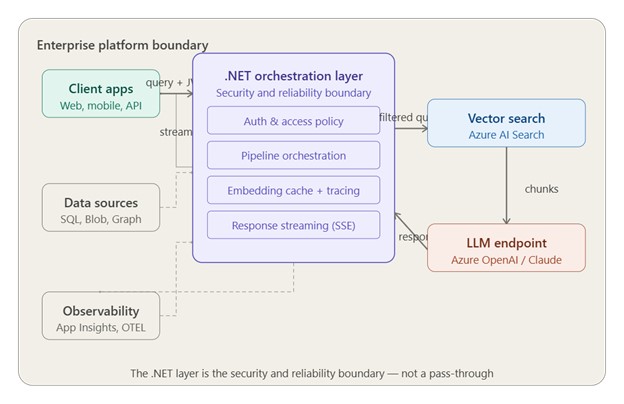
The most common mistake engineering teams make when adding AI to an existing .NET platform is treating the AI service as a thin pass-through: receive a query, forward it to an LLM, return the result. This works in a prototype. It falls apart in production.
Your .NET service is the intelligence layer. It decides whether the AI feature is trustworthy, secure, performant, and observable. The vector store and the LLM are downstream dependencies it manages, not peers it defers to.
Auth enforcement, pipeline orchestration, caching, and streaming are not features you bolt on later. They are the architecture. Every request passes through all four. Every policy decision happens there. Build them in early or spend twice the time pulling apart a system that didn’t account for them.
The six-stage query pipeline
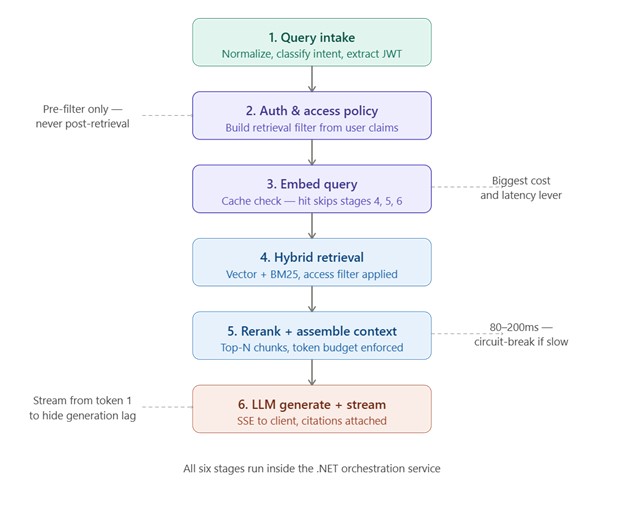
A production RAG query is not a single API call. It’s an orchestrated pipeline of six discrete stages, each with its own failure mode, latency budget, and caching opportunity. All six live inside your .NET orchestration service.
Also Read: Which MVP is Right for You?
Three of them deserve extra attention.
Stage 2, access filtering, is the most important decision in any enterprise deployment. The filter must go into the vector search query itself, enforced server-side before any data is returned. If you apply it after retrieval as an application-layer check, the LLM has already processed unauthorized content. This isn’t a theoretical edge case. It’s a design error that ships silently and shows up in a security review months later.
Stage 3 is your biggest performance win. A query embedding cache keyed on the normalized query hash means repeated questions (a large share of real-world traffic) skip retrieval, reranking, and LLM generation entirely. At scale, this is your largest single cost reduction.
Stage 6 is where perceived latency is controlled. LLM generation dominates the total time budget by a wide margin. Streaming from the first token via Server-Sent Events turns a 2–4 second wait into a response that starts arriving immediately, even if total generation time hasn’t changed. Users notice.
The ingestion pipeline: a separate service with a separate SLA
The ingestion pipeline (converting raw documents into indexed vectors) operates very differently from the query pipeline. It’s batch-oriented, tolerant of latency, and subject to periodic schema changes as your chunking strategy matures. It should be a separate .NET Worker Service or Azure Function, not a background task embedded in your query API.
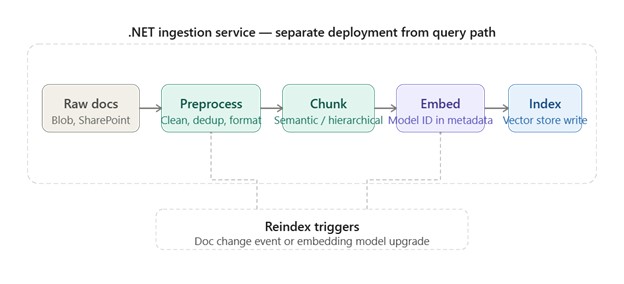
Chunking strategy matters more than most teams realize until retrieval quality is already disappointing. Fixed-size chunking, the default in most RAG tutorials, fractures semantic units’ mid-sentence and produces chunks that can’t stand alone as answers. Semantic chunking groups content by meaning boundaries. Hierarchical chunking goes further: it maintains parent-child relationships between document sections and sub-sections, letting the system retrieve a precise small chunk for ranking while expanding to the full section for context assembly. For enterprise technical documentation, hierarchical chunking consistently outperforms fixed-size approaches.
One detail that tends to get skipped: every vector written to the index should carry the embedding model ID and version in its metadata. When the embedding model is upgraded (and it will be), that metadata is what lets your service detect version skew and trigger selective reindexing rather than a full corpus rebuild. It’s five minutes of work up front that saves hours later.
Also Read: Boost Your Online Sales This Holiday Season by Focusing On These Critical eCommerce KPI’s
Where the time goes: a realistic latency budget
Engineering leads get asked about latency constantly, usually right after something has gone wrong. Here’s where time goes in a production RAG call.
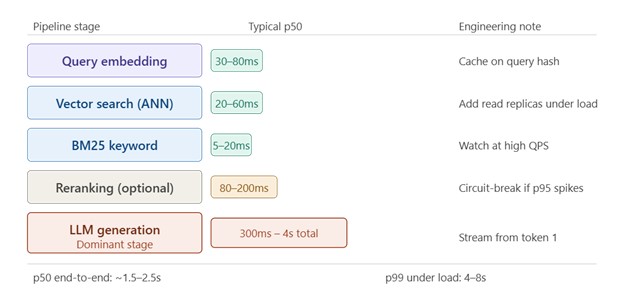
LLM generation is an order of magnitude larger than every other stage combined, and it drives two decisions. First, streaming isn’t optional. Returning a full generated response as a single payload means users stare at a spinner for 2–4 seconds before seeing anything. Streaming via SSE starts delivering tokens in under 400ms even when total generation takes four seconds. Second, the embedding cache at stage 3 is the single biggest optimization available, because a cache hit skips stages 4, 5, and 6 entirely, including the most expensive one. These two facts should drive your performance work more than anything else.
What .NET gives you that Python frameworks don’t account for
Most RAG tutorials assume a greenfield Python service with no existing platform context. Enterprise .NET teams inherit infrastructure those frameworks don’t address, and that’s an advantage.
Authentication is already solved. JWT validation, claims extraction, role resolution: your existing ASP.NET Core middleware handles all of it. The RAG pipeline slots directly into that infrastructure. The access policy derived from the user’s claims becomes the OData filter submitted to Azure AI Search. No custom auth layer to build or maintain.
The LLM provider should be an abstracted dependency from day one. Register the client behind an interface in the DI container. Switching from Azure OpenAI to Claude, or to a fine-tuned internal model, should be a config change, not a refactor. It also makes A/B testing between providers straightforward as the model market keeps shifting.
Distributed tracing is already your observability standard. Each pipeline stage should be a named Activity span in your existing OpenTelemetry or Application Insights setup. Measure stage-level latency, not just end-to-end, so you know which stage to address when p99 spikes. The metrics that matter stage latency per pipeline step, embedding cache hit rate, retrieval candidate count, token budget utilization per request, and reranked p95 latency.
Resilience patterns apply directly. The Polly retries policies, circuit breakers, and timeout strategies your team already uses on downstream HTTP calls apply to embedding service calls, retrieval calls, and LLM calls without modification. The RAG pipeline is a set of HTTP dependencies. Treat it that way.
Production failure modes to design against now
A few failure modes come up so often in enterprise RAG deployments that they’re worth naming upfront, because they tend to reach production before anyone has thought to design against them.
Context window overflow. Without a token budget enforcer in context assembly, you will periodically exceed the model’s context limit and get an opaque API error that looks like a network failure. Build the enforcer into the assembly stage with explicit budgets for system prompt, query text, retrieved chunks, and response headroom. Trim from the least-relevant chunks first, not from the query or system prompt.
Embedding model version skew. If the model serving live queries was updated while the index was not re-embedded (due to a config change, service restart, or silent dependency upgrade), similarity scores become meaningless and retrieval quality degrades without any error signal. Add a startup health check that reads the model ID from a sample of index metadata and compares it against the configured embedding model. If they differ, alert before traffic hits.
Access control applied post-retrieval. This deserves its own entry because it ships more often than it should. If the access filter runs in .NET application code after search results are returned, the LLM has already processed all retrieved content, including unauthorized chunks. The filter must be submitted as part of the search query, server-side, before any results are returned. Azure AI Search OData filters applied at query time provide this guarantee.
Reranker cascade under sustained load. Cross-encoder reranking is expensive. Under sustained QPS, reranker latency can spike and cascade through the pipeline. Implement a latency-based circuit breaker that monitors the reranker’s rolling p95 and falls back to vector-only ranking when the threshold is exceeded. Some quality degradation is fine. A timeout cascade that takes down the query service is not.
Principles for engineering leads
The teams shipping reliable .NET AI features tend to make a small set of consistent decisions early. Not because they were particularly clever, but because they thought about what production would look like before writing too much code.
They separated the ingestion service from the query service from day one, with different deployments, different scaling, and different on-call runbooks. They instrumented every pipeline stage as a named trace span before going to production, so they had latency data by stage from the first week. They abstracted the LLM provider behind an interface before the first production deployment, knowing the model landscape would shift. They enforced access policy inside the search query, not in application code. And they treated reindexing as an automated, observable pipeline rather than a manual script that gets run when someone remembers.
None of these are hard decisions. They’re just much easier to make at the start than to retrofit six months in, when the system has real users and the team has other priorities.
The LLM is a commodity API. What makes an enterprise AI feature work in production is the .NET orchestration layer around it: auth enforcement, caching, pipeline coordination, streaming, observability. That’s always been backend engineering. It still is.